Our Research

Our latest JEI poll shows American Jews are still overwhelmingly pro-Israel but also very critical of Israel and Prime Minister Netanyahu. A majority are concerned that Netanyahu’s actions have increased antisemitic and anti-Israel sentiment. While this is more prevalent among Democrats, even a third of GOP Jews are greatly concerned. This poll also shows the divisions on some recent hot button issues. For instance, most Democrats support cutting aid to Israel, while majorities of independents and Republicans are opposed. There is also a division on the recent pro-Israel action in primary elections – with over a third of Jews feeling it has made things worse, while an increasing plurality feel it is more important than ever. Jews Are Pro-Israel But Very Critical Of Netanyahu, Though Not Focused On The Upcoming Israeli Election An overwhelming 86% of American Jews identify themselves as Pro-Israel, including 65% saying they are pro-Israel but critical of some or many of Israeli government policies. This is barely changed from the March JEI poll which showed 86% pro-Israel and 63% critical. Nearly three quarters (71%) see Israel favorably compared to 25% unfavorably – barely changed from March (71%/24%). At the same time, 61% have an unfavorable view of Netanyahu, with 34% favorable. This is within a point of Netanyahu’s standing from the JEI post-election poll in November 2024 which showed 33% favorable, 61% unfavorable. While 80% of American Jews are following the November elections in the U.S., only 38% are following the October elections in Israel. They do, however, have a strong preference in the outcome with 60% wanting Netanyahu replaced, including 53% feeling strongly. Only 16% of American Jews want to see him reelected. A Majority Are Concerned Netanyahu Has Increased Anti-Semitic And Anti-Israel Feelings Nearly half of American Jews are concerned about antisemitic rhetoric in the Republican (48% a great deal of concern) and Democratic (44%) Parties. Even among partisans roughly three in ten are greatly concerned about antisemitic rhetoric within their own party, with 29% of Republicans saying that about the GOP and 34% of Democrats saying it about their party. A 56% majority of Jews have a great deal of concern that “Israel’s actions under Netanyahu have increased antisemitism and anti-Israel sentiment in the U.S.” Two thirds (65%) of Democratic Jews feel this way, and nearly half (46%) of independents and a third (34%) of Republicans. Most Democrats Would Cut Aid To Israel, But Republicans & Independents Are Opposed A 52% majority of Jews support cutting or eliminating aid to Israel, with 17% supporting “eliminating all $3.3 billion in military aid that the U.S. provides Israel” and 36% preferring to cut but not eliminate aid. Four in ten (40%) would keep aid at current levels, with 8% not sure. There are stark differences on partisanship, with nearly two thirds of Democrats (63%) wanting to cut or eliminate aid, and a similar two thirds of Republicans (67%) and independents (65%) for keeping current levels. Four in ten (40%) Jews are concerned about Congressional support for eliminating aid for “defensive weapons like Iron Dome” (40%), only slightly higher than concern for eliminating “offensive weapons” (36%). A majority of Republicans are concerned about cuts to either offensive (54%) or defensive weapon (56%), while less than half of independents are concerned (44% defensive, 45% offensive) and only a third of Democrats (34% defensive, 29% offensive.) Still there is more of a cost for a Member of Congress voting to cut aid, than a benefit. Nearly half (47%) are less likely to support a Member voting to cut aid, including 36% of those who support cutting aid themselves. Only one in five (21%) are more likely to vote for a Member cutting aid. Even among those who support cuts, only 13% are more likely to support a Member voting that way. Views On AIPAC And The Recent Primary Battles Are Mixed, Even Among Democrats A majority (51%) of American Jews have heard at least something about pro-Israel activity in this year’s primary elections – up from 38% in March. However, higher awareness has not dramatically changed opinions. A narrow 39% plurality support the pro-Israel activity in the primaries, 35% oppose it, and 26% are unsure; very similar to March (37% support, 32% oppose, 31% not sure). Given a choice between two statements, 45% believe “With increasing anti-Israel sentiment and threats to Israel, it is more important than ever for pro-Israel groups to play an active role against candidates who are not supportive enough of a strong US-Israel relationship”, while 37% believe that “These heavy-handed efforts by pro-Israel groups in primary elections make things worse by turning voters against a strong US-Israel relationship, and they should stop.” Large majorities of Republicans and independents believe it more important than ever for pro-Israel groups to get involved in the primaries. But while Democrats lean the other way, they are more torn – with 46% saying the pro-Israel activity is making things worse, but the majority of Democrats either think it’s more important than ever (34%) or are not sure (20%). Indeed, views of AIPAC, the biggest pro-Israel spender in primaries, are mixed, with 42% favorable, 35% unfavorable, and 24% not sure. AIPAC is seen favorably by most independents (55% favorable, 15% unfavorable) and Republicans (71% favorable, 12% unfavorable). Jewish Democrats are 44% unfavorable, with a majority either favorable (31%) or not sure (25%). Moreover, Democratic Jews do not fit easily into one box on AIPAC. Nearly half (45%) agree with the statement “AIPAC is being unfairly singled out for doing just what other advocacy groups do”. Yet 30% agree they cannot vote for a candidate who accepts money from AIPAC, while 19% cannot support a candidate who refuses money from AIPAC. While American Jews are generally together on being pro-Israel even if critical of the government, there are divisions on what should be done in the U.S. on aid and elections.

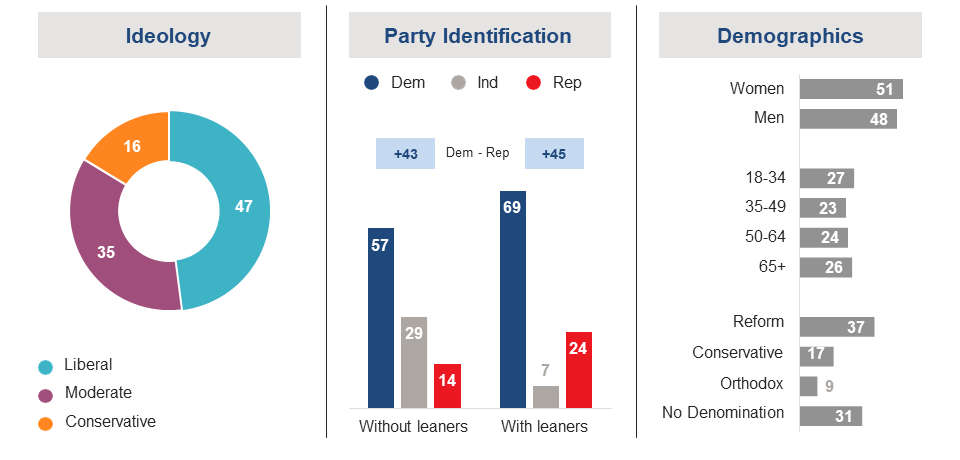
Jewish Voters Highly Engaged, Prioritize Domestic Issues; Strong Support for Israel and Caution on Military Action and Advocacy This recent March 2026 national survey finds that American Jewish adults overwhelmingly affirm Israel’s right to exist while also expressing caution about the current U.S. military escalation in Iran. Views on pro-Israel political spending, however, remain mixed. AIPAC has an overall favorable impression of 39%, DMFI 32%, and J Street 18%. Some key findings also include the following: Turnout and partisanship: Registered respondents report their very high intention to turn out for the November 2026 midterm elections. About seven in ten identify as Democrats (many strongly), roughly one in four compared to Republicans, with the remainder being made up of Independents. Democrats hold a substantial advantage in hypothetical congressional votes in respondents’ districts. Donald Trump receives broad net disapproval, and Benjamin Netanyahu is viewed unfavorably by more respondents than favorably. Israel and Zionism: There are mixed signals over the concept of Zionism, with the majority seeing Zionism favorably, but only a third calling themselves Zionists. Roughly seven in ten hold a favorable view of Israel; 87% endorse Israel’s right to exist as a Jewish homeland. Most see Zionism as Jewish self‑determination, though only a third self‑identify as Zionist. A surprisingly large number are unsure about the definition of Zionism. Foreign policy and military action: A majority of respondents oppose current U.S. military action against Iran and say the president should have sought congressional approval for strikes. Many prioritize preventing Iran from obtaining nuclear weapons but favor clear objectives and oversight over unilateral escalation. 2026 Midterm Elections & Party Affiliations: American Jews are voting heavily Democratic in the midterm election for Congress. At the same time, Jews have questions about what the Democratic Party stands for, particularly on Israel. Jewish Republicans are most identified as pro-Israel, which is one of their biggest image advantages over Democrats. Pro‑Israel advocacy and spending: Opinions are split on outside groups spending in primaries—about a third support such spending, a third oppose it, and many are undecided. Respondents are nearly evenly divided on whether aggressive outside intervention helps or harms U.S.–Israel relations. Antisemitism and public debate: A large majority say some criticism of Israel slips into antisemitic tropes, and a significant share also believes some defenders wrongly label policy criticism as antisemitism. There is also concern about how antisemitism is becoming a part of the increasingly heated discussions over U.S.-Israel issues, by both sides. A large majority of U.S. Jews see too many critics of Israel using language about Jews that plays into antisemitism, whether intended or not. At the same time, a majority of Jews feel too many supporters of Israel use claims of antisemitism to avoid legitimate debate over policy. Domestic Issues are Important: Democrats are viewed positively on healthcare, abortion rights, fair elections, and middle class advocacy, while Republicans are viewed as pro-Israel but excessively conservative and unwilling to oppose the President. The sample of respondents: The current distribution of Jewish voters by party affiliation: 69% Democratic, 24% Republican, and 7% Independent. Poll respondents are mixed gender, highly educated, and religiously plural within Judaism (Reform and unaffiliated are the largest). About one‑third belong to a synagogue, but religious practice varies. Jewish women Voters: There are more female Democrats likely to hold reinforcing views, contributing to the party's electoral advantage, thereby fueling the midterm margin. The partisan divide is even larger among women. Nearly three-quarters (74%) of Jewish women identify as Democrats, including 50% who are strong Democrats, and 24% who identify as Democratic Socialists. Likely Jewish women voters are supporting the Democrats in the generic vote: 78% Democratic, 19% Republican, and only 3% undecided. The Democratic vote margin increases significantly with age among Jewish women. Women ages 18-29 vote +46 Democratic, rising to +60 among those 40–59 and +58 among those 60 and older. These margins exceed those of the overall Jewish electorate, where voters ages 40–59 and 60+ both register a +48 Democratic advantage. The strength of Jewish identity also follows a consistent pattern. Among women who place lower importance on being Jewish, the Democratic advantage is +74, compared to +61 among the overall electorate. Among those who place higher importance on being Jewish, Jewish women still lean more Democratic than the overall electorate, at +41 versus +36. Jewish women are also more likely to disapprove of Trump’s job performance and the current U.S. military action against Iran. They are four points more likely than the overall electorate to disapprove of Trump’s job performance (77% vs. 73%) and the U.S. military action in Iran (59% vs. 55%). Jewish voters combine strong civic engagement and a clear Democratic preference with nuanced views that favor protecting Israel while insisting on democratic oversight, strategic clarity, and careful political tactics. Well-positioned issues that resonate for candidates and organizations in the upcoming 2026 midterm elections include emphasizing support for Israel alongside respect for congressional authority, clear policy goals, and sensitive messaging on antisemitism. "This poll reinforces a simple truth that the Jewish community is not monolithic, and the Jewish vote should not be taken for granted. Their concerns extend beyond Israel and Iran. It also indicates a critical need for education about Israel's history and the meaning of Zionism. These needs have never been more urgent than they are today," said Barbara Goldberg Goldman, JEI Chair. These analyses are based on the final release of the findings of a national survey of 800 Jewish registered voters, with an oversample to yield 600 Jewish women. The survey was conducted for JEI by The Mellman Group using a high-quality online national panel from March 13-23, 2026. The margin of error for the sample as a whole is +/- 3.5% at the 95% level of confidence (higher for subgroups).
POLL: JEWISH AMERICANS OPPOSE TRUMP EXECUTIVE ORDERS
BY OVERWHELMING MAJORITIES
- Poll Briefing Today/Thursday 4/24 at 1pm -
U.S. Jews Oppose Executive Orders and other actions by factors of 3, 4, and even 5-1

Harris’ share of Jewish vote declines, but still within recent historical range (Washington) – A new non-partisan survey by the Jewish Electorate Institute (JEI) released Thursday shows very high levels of Jewish voters backing Kamala Harris and Democrats in the 2024 elections. The poll, conducted for the Jewish Electorate Institute by The Mellman Group from October …

Harris’ share of Jewish vote declines, but still within recent historical range (Washington) – A new non-partisan survey by the Jewish Electorate Institute (JEI) released Thursday shows very high levels of Jewish voters backing Kamala Harris and Democrats in the 2024 elections. The poll, conducted for the Jewish Electorate Institute by The Mellman Group from October 30 to …
JEI New Analysis of National Survey of Jewish Voters A new analysis from the non-partisan Jewish Electorate Institute (JEI) indicates that Jewish voters could play a decisive role in determining control of Congress and the White House in the 2024 elections. Conducted by Population Mapping Consulting and Research alongside the Jewish Demography Project at the …
A new survey from the non-partisan Jewish Electorate Institute indicated that 67% of Jewish voters would vote for President Biden’s reelection were the ballot held at the time of the poll. The survey, conducted from April 16-21, 2024, by GBAO Strategies, measured the attitudes of the American Jewish electorate regarding their preferences on subjects including …
A new survey from the non-partisan Jewish Electorate Institute found that 74% of Jewish voters approve of President Biden’s handling of the war between Israel and Hamas. The survey, conducted from November 5-9 by GBAO Strategies, measured the attitudes of the American Jewish electorate in response to Hamas’s attack on Israel, the threat of antisemitism, …
The non-partisan Jewish Electorate Institute (JEI) released its first national survey of Jewish voters in 2023, conducted by GBAO Strategies between June 4 and June 11. It included interviews with 800 self-identified Jewish voters. Among other results, the poll found that Jewish voters remain very focused on the cultural issues that divide the country – …
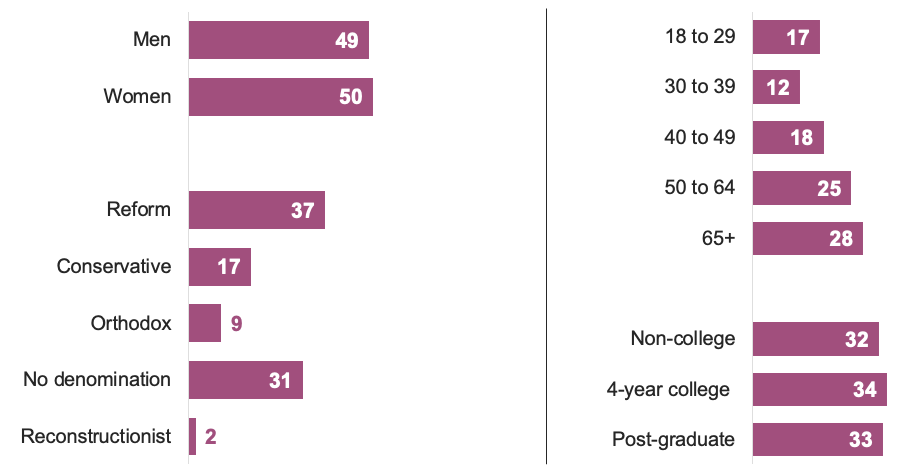
The Jewish Electorate Institute (JEI) released a national survey of 800 Jewish voters conducted by GBAO Strategies on behalf of the non-partisan Jewish Electorate Institute was conducted online between August 25 and September 1. The new poll of Jewish voters finds strong support for President Biden and Congressional Democrats, demonstrating higher approval ratings from these …
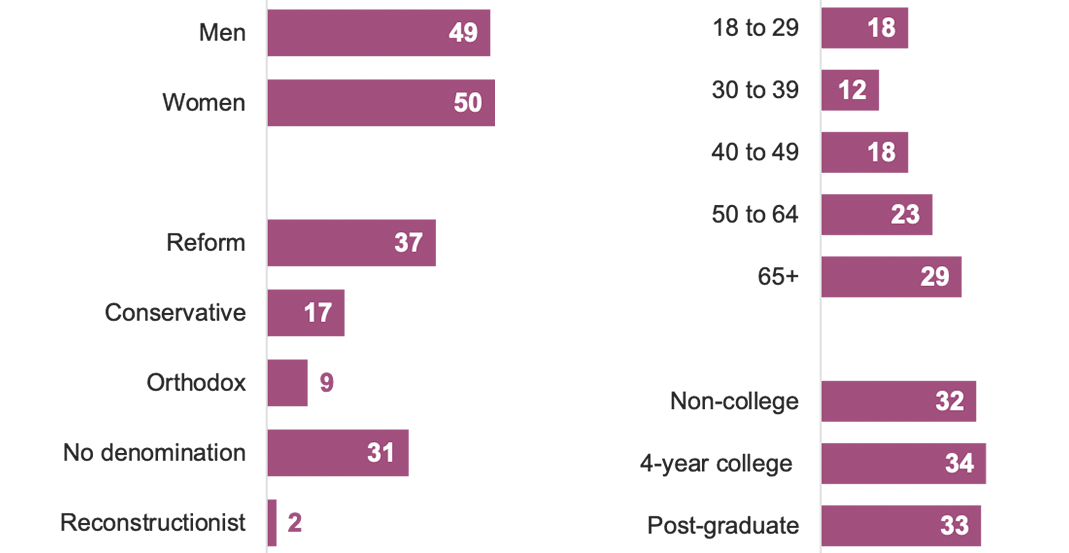
The Jewish Electorate Institute (JEI) today released the results of a survey conducted on behalf of JEI from March 3 through April 3 of 800 self-identified registered Jewish American voters by GBAO Strategies, a research-based strategic counsel for candidates running for office, non-profits, and other organizations seeking to better understand public opinion. JEI Chair Martin …
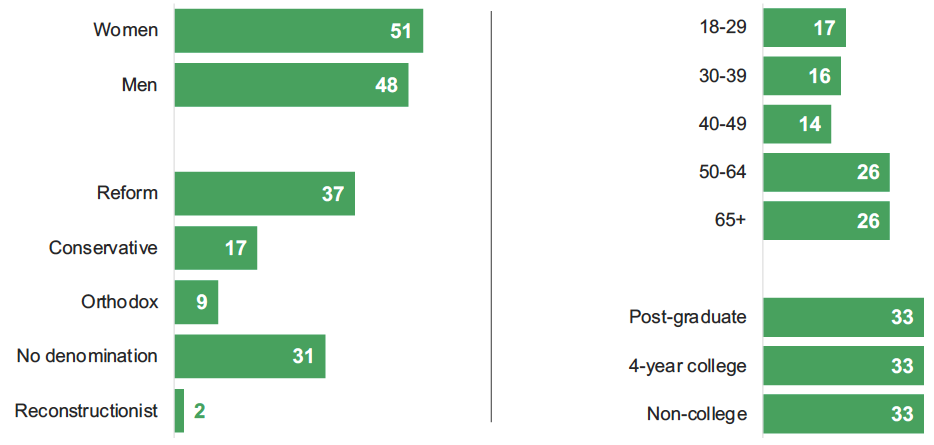
The first major poll of Jewish voters since Joe Biden became President and since recent hostilities between Israel and Hamas demonstrates that Jewish Americans continue to overwhelmingly identify as Democrats and support President Joe Biden with an 80% rate of approval. It is the first poll of its kind to demonstrate that Jewish Americans rank …
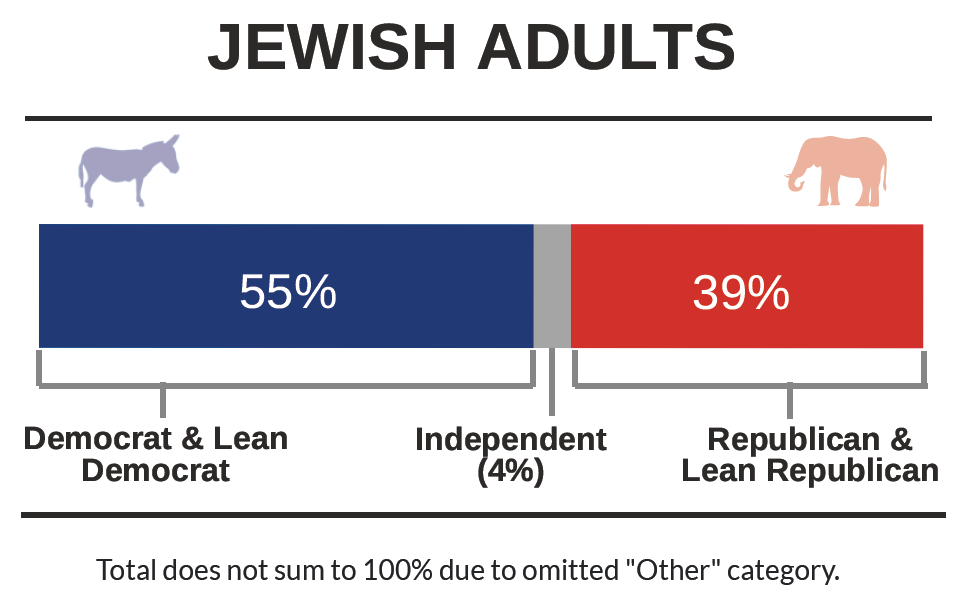
At the request of the non-partisan Jewish Electorate Institute, researchers at the American Jewish Population Project at Brandeis University’s Social Research Institute conducted an analysis of hundreds of national surveys of US adults to describe the Jewish electorate in each of the 435 districts of the 116th US Congress and the District of Columbia. Surveys …
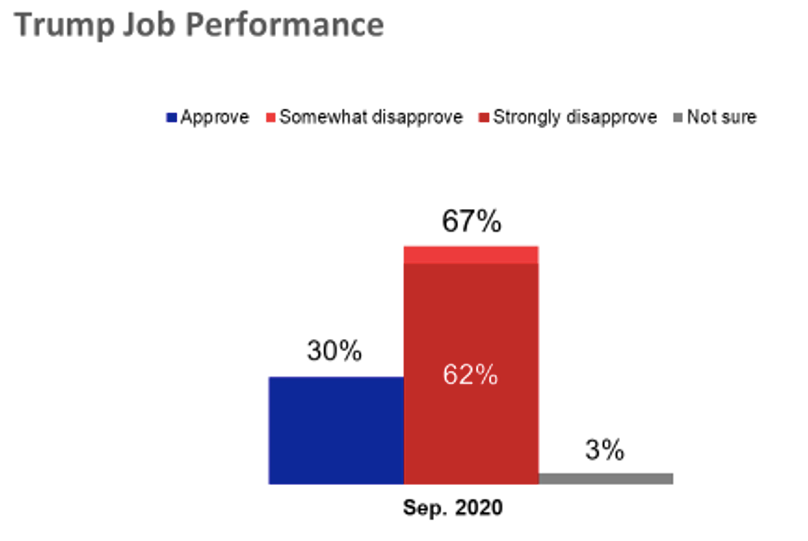
On behalf of the non-partisan Jewish Electorate Institute (JEI), Garin-Hart-Yang conducted an online survey of 810 Jewish voters nationally who self-identify as Jewish and indicate that they are likely to vote in the November 2020 election. The survey, which was conducted from September 2 to 7, 2020, has a margin of error of ±3.5 percentage …
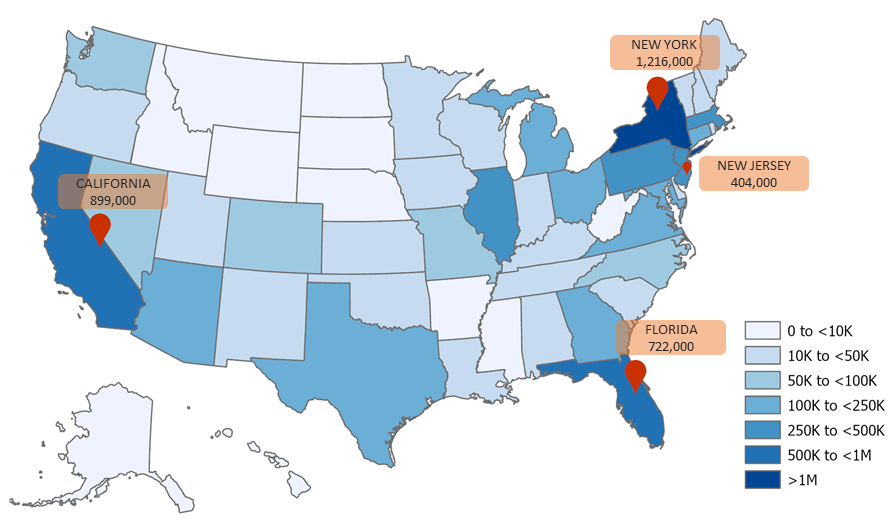
Summary At the request of the non-partisan Jewish Electorate Institute, researchers at the American Jewish Population Project at Brandeis University’s Steinhardt Social Research Institute conducted an analysis of hundreds of national surveys of US adults to describe the Jewish electorate in each of the 435 districts of the 116th Congress and the District of Columbia. …