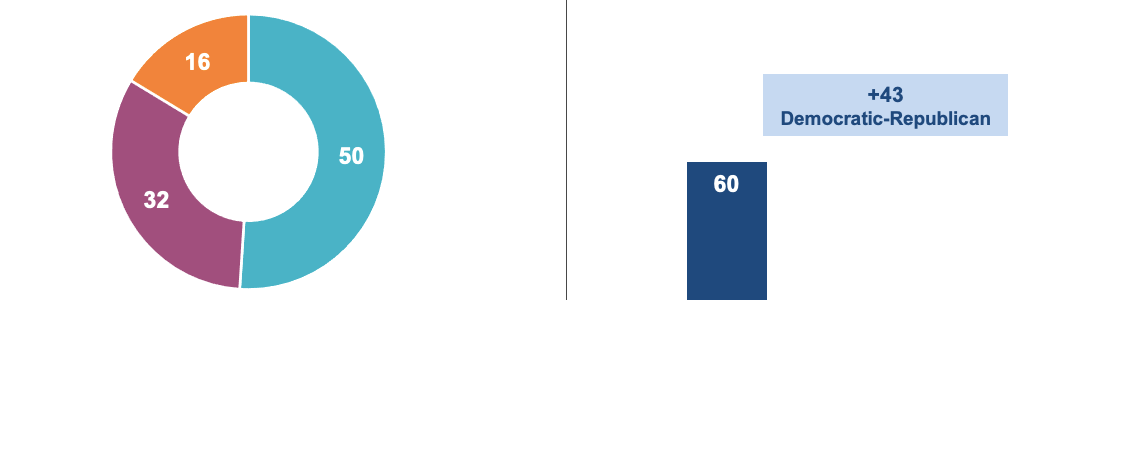
The Jewish Electorate Institute (JEI) released a national survey of 800 Jewish voters conducted by GBAO Strategies on behalf of the non-partisan Jewish Electorate Institute was conducted online between August 25 and September 1. The new poll of Jewish voters finds strong support for President Biden and Congressional Democrats, demonstrating higher approval ratings from these voters than among the general population, with 70% saying they approve of President Biden’s job performance and will support a Democratic candidate in November.
“Despite the political divide in the country overall, most Jewish voters share priorities and beliefs on the key issues that will decide elections in November,” said former Rep. Martin Frost (D-TX), Chair of JEI.
“Especially on securing the future of democracy, protecting abortion access, and taking action on gun safety, an overwhelming majority of Jewish voters are motivated to vote in November for candidates who share their values.”
Key findings of the poll released today include:
70% of Jewish voters approve of the way Joe Biden is handling his job as president, a 7% increase from a JEI poll in April 2022.
70% of Jewish voters would support a Democratic candidate for Congress if the election were held today while only 24% would vote for the Republican candidate, representing a 10% increase in the Democratic lead over a JEI poll in April 2022.
19% of Jewish voters hold a favorable opinion of Donald Trump
92% of Jewish voters are concerned about antisemitism, and by a 52-20% margin, trust Democrats more than Republicans to fight it.
61% of Jewish voters are more concerned about antisemitism originating from right-wing groups and individuals compared to 24% who are more concerned about antisemitism coming from left-wing groups and individuals.
82% of Jewish voters disapprove of the Supreme Court’s decision to overturn Roe v. Wade, with 56% saying that the decision makes them more motivated to vote.
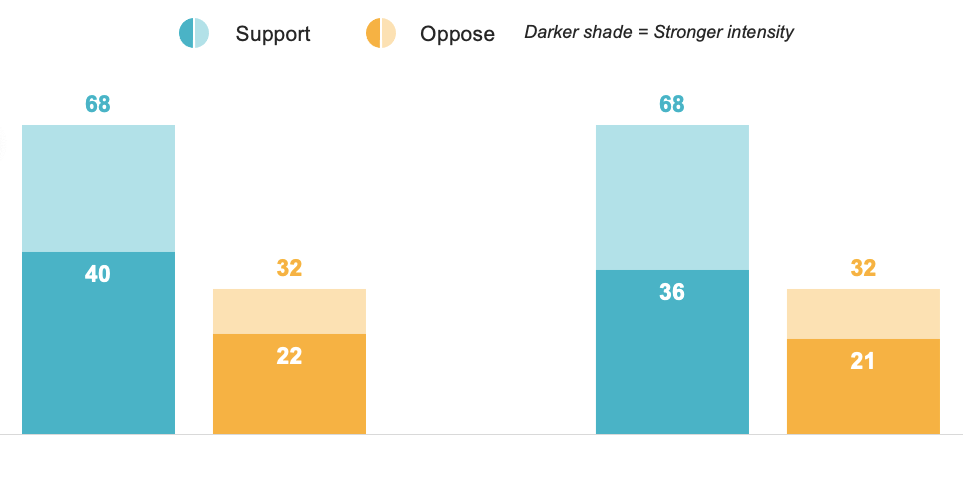
68% of Jewish voters support the U.S. reentering the Iran nuclear deal.
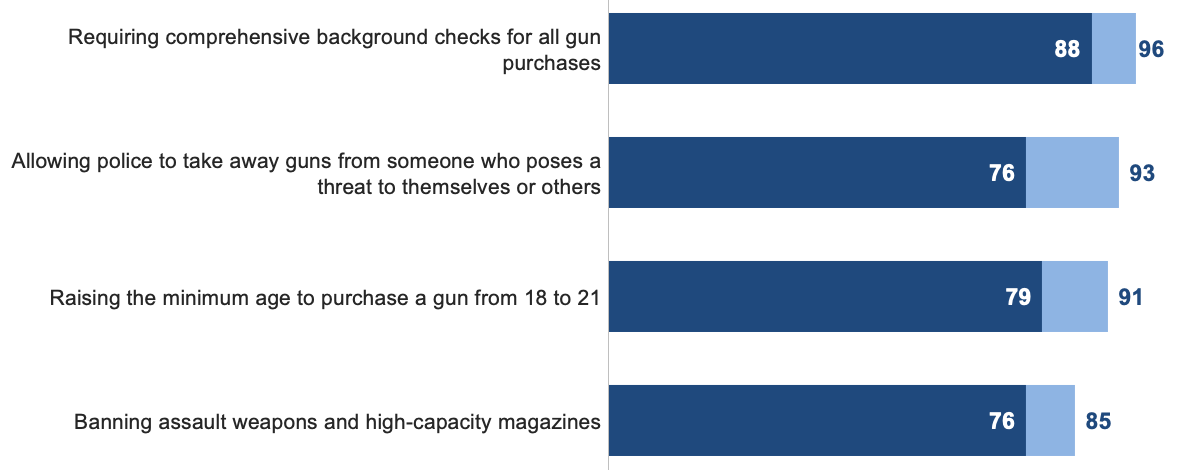
The survey found near-unanimous support for gun safety measures, with 96% of Jewish voters supporting requiring comprehensive background checks for all gun purchases and 91% support raising the minimum age to purchase a gun from 18 to 21.
Rate your level of motivation to vote in the November election on a scale from 0 to 10.
Congressional Vote
Thinking about the elections this November, if the general election for U.S. Congress were being held today, for whom would you vote?
Biden Job Approval
Do you approve or disapprove of the job Joe Biden is doing as President?
Favorability
Issue Priorities
Please indicate which two of these issues are most important to you when deciding how you will vote in the November 2022 Congressional election.
Issues Priorities by Denomination
Please indicate which two of these issues are most important to you when deciding how you will vote in the November 2022 Congressional election.
Issues Priorities by Age
Please indicate which two of these issues are most important to you when deciding how you will vote in the November 2022 Congressional election.
Roe v. Wade
Do you approve or disapprove of the recent U.S. Supreme Court decision that overturned Roe v. Wade and allows states to ban abortion?
Roe v. Wade – Motivation
Has the decision to overturn Roe v. Wade made you more motivated to vote, less motivated to vote, or made no difference on your motivation to vote in the November 2022 mid-term election?
January 6th Hearings
How closely have you followed the Congressional hearings investigating the January 6 attack on the U.S. Capitol?
January 6th Hearings – Motivation
Have the January 6 hearings made you more motivated to vote, less motivated to vote, or made no difference on your motivation to vote in the November 2022 mid-term election?
Gun Laws
Do you think gun laws in the United States are too restrictive, not restrictive enough, or about right?
Gun Reform Proposals
Antisemitism
How concerned are you about antisemitism in the US?
Are you more concerned about antisemitism that originates from left-wing groups and individuals or antisemitism that originates from right-wing groups and individuals?
Who do you trust more to fight antisemitism?
Israel Attachment
How emotionally attached are you to Israel?
Israel Priority – Reasoning
(Among respondents who did not cite Israel as one of their top two issues) Earlier in this survey, you did not cite Israel as one of your top issues determining your vote in the November 2022 Congressional election. Which of the following reasons best explain why Israel is not one of your top issues?
Re-entering the Nuclear Agreement with Iran
As you may know, President Trump withdrew the United States from the nuclear agreement that the United States made with Iran and five other countries. This agreement lifts economic sanctions against Iran in exchange for Iran dismantling its nuclear weapons program and allowing international inspectors to monitor Iran’s facilities. Some people think that we should re-enter the agreement, and some people think that we should not re-enter this agreement. Do you support or oppose the United States re-entering this agreement?
Support for re-entering the Iran deal is consistent with JEI national survey of Jewish voters from April 2022
The latest Jewish Electorate Institute survey gives Democrats a commanding 71 percent to 23 percent advantage among Jewish voters on the generic congressional ballot, virtually unchanged from its March poll. Sixty-nine percent identify as Democrats, while 24 percent identify as Republicans. The same poll contains a less comfortable set of numbers, though: 57 percent of Jewish voters overall say antisemitism is increasing within the Democratic Party, while 35 percent of Jewish Democrats say the rise of anti-Israel Democratic candidates has made it harder for them personally to identify as Democrats. The votes may still be staying Democratic, but for some Jewish voters, identification with the party is becoming more complicated.
Our latest JEI poll shows American Jews are still overwhelmingly pro-Israel but also very critical of Israel and Prime Minister Netanyahu. A majority are concerned that Netanyahu’s actions have increased antisemitic and anti-Israel sentiment. While this is more prevalent among Democrats, even a third of GOP Jews are greatly concerned. This poll also shows the divisions on some recent hot button issues. For instance, most Democrats support cutting aid to Israel, while majorities of independents and Republicans are opposed. There is also a division on the recent pro-Israel action in primary elections – with over a third of Jews feeling it has made things worse, while an increasing plurality feel it is more important than ever. Jews Are Pro-Israel But Very Critical Of Netanyahu, Though Not Focused On The Upcoming Israeli Election An overwhelming 86% of American Jews identify themselves as Pro-Israel, including 65% saying they are pro-Israel but critical of some or many of Israeli government policies. This is barely changed from the March JEI poll which showed 86% pro-Israel and 63% critical. Nearly three quarters (71%) see Israel favorably compared to 25% unfavorably – barely changed from March (71%/24%). At the same time, 61% have an unfavorable view of Netanyahu, with 34% favorable. This is within a point of Netanyahu’s standing from the JEI post-election poll in November 2024 which showed 33% favorable, 61% unfavorable. While 80% of American Jews are following the November elections in the U.S., only 38% are following the October elections in Israel. They do, however, have a strong preference in the outcome with 60% wanting Netanyahu replaced, including 53% feeling strongly. Only 16% of American Jews want to see him reelected. A Majority Are Concerned Netanyahu Has Increased Anti-Semitic And Anti-Israel Feelings Nearly half of American Jews are concerned about antisemitic rhetoric in the Republican (48% a great deal of concern) and Democratic (44%) Parties. Even among partisans roughly three in ten are greatly concerned about antisemitic rhetoric within their own party, with 29% of Republicans saying that about the GOP and 34% of Democrats saying it about their party. A 56% majority of Jews have a great deal of concern that “Israel’s actions under Netanyahu have increased antisemitism and anti-Israel sentiment in the U.S.” Two thirds (65%) of Democratic Jews feel this way, and nearly half (46%) of independents and a third (34%) of Republicans. Most Democrats Would Cut Aid To Israel, But Republicans & Independents Are Opposed A 52% majority of Jews support cutting or eliminating aid to Israel, with 17% supporting “eliminating all $3.3 billion in military aid that the U.S. provides Israel” and 36% preferring to cut but not eliminate aid. Four in ten (40%) would keep aid at current levels, with 8% not sure. There are stark differences on partisanship, with nearly two thirds of Democrats (63%) wanting to cut or eliminate aid, and a similar two thirds of Republicans (67%) and independents (65%) for keeping current levels. Four in ten (40%) Jews are concerned about Congressional support for eliminating aid for “defensive weapons like Iron Dome” (40%), only slightly higher than concern for eliminating “offensive weapons” (36%). A majority of Republicans are concerned about cuts to either offensive (54%) or defensive weapon (56%), while less than half of independents are concerned (44% defensive, 45% offensive) and only a third of Democrats (34% defensive, 29% offensive.) Still there is more of a cost for a Member of Congress voting to cut aid, than a benefit. Nearly half (47%) are less likely to support a Member voting to cut aid, including 36% of those who support cutting aid themselves. Only one in five (21%) are more likely to vote for a Member cutting aid. Even among those who support cuts, only 13% are more likely to support a Member voting that way. Views On AIPAC And The Recent Primary Battles Are Mixed, Even Among Democrats A majority (51%) of American Jews have heard at least something about pro-Israel activity in this year’s primary elections – up from 38% in March. However, higher awareness has not dramatically changed opinions. A narrow 39% plurality support the pro-Israel activity in the primaries, 35% oppose it, and 26% are unsure; very similar to March (37% support, 32% oppose, 31% not sure). Given a choice between two statements, 45% believe “With increasing anti-Israel sentiment and threats to Israel, it is more important than ever for pro-Israel groups to play an active role against candidates who are not supportive enough of a strong US-Israel relationship”, while 37% believe that “These heavy-handed efforts by pro-Israel groups in primary elections make things worse by turning voters against a strong US-Israel relationship, and they should stop.” Large majorities of Republicans and independents believe it more important than ever for pro-Israel groups to get involved in the primaries. But while Democrats lean the other way, they are more torn – with 46% saying the pro-Israel activity is making things worse, but the majority of Democrats either think it’s more important than ever (34%) or are not sure (20%). Indeed, views of AIPAC, the biggest pro-Israel spender in primaries, are mixed, with 42% favorable, 35% unfavorable, and 24% not sure. AIPAC is seen favorably by most independents (55% favorable, 15% unfavorable) and Republicans (71% favorable, 12% unfavorable). Jewish Democrats are 44% unfavorable, with a majority either favorable (31%) or not sure (25%). Moreover, Democratic Jews do not fit easily into one box on AIPAC. Nearly half (45%) agree with the statement “AIPAC is being unfairly singled out for doing just what other advocacy groups do”. Yet 30% agree they cannot vote for a candidate who accepts money from AIPAC, while 19% cannot support a candidate who refuses money from AIPAC. While American Jews are generally together on being pro-Israel even if critical of the government, there are divisions on what should be done in the U.S. on aid and elections.
September 23, 2026 The Honorable Mike Johnson Speaker of the United States House of Representatives United States House of Representatives Washington, DC 20515 Dear Mr. Speaker: I submit this statement for the record in support of H.R. 10052 and S. 5289, the Right to Worship Act. I am grateful to Representatives Brad Knott, Tom Suozzi, Michael Lawler, and Josh Gottheimer and Senators Ted Cruz and Elissa Slotkin for their bipartisan leadership in introducing this important legislation to protect the fundamental right of Americans to worship without fear, intimidation, or deliberate disruption. For Jewish Americans, this protection is particularly urgent. Synagogues should be places where Jewish families can gather in prayer, celebrate Shabbat and holidays, educate their children, and sustain their communities. No one should have to approach a synagogue wondering whether protesters will block the entrance, intimidate worshippers, prevent families from entering, or deliberately disrupt religious services. The Right to Worship Act recognizes a basic principle of religious liberty: Americans must be able to enter their houses of worship and participate in religious services without being subjected to conduct that meaningfully interferes with their ability to worship. The legislation establishes a narrowly tailored 100-foot protection zone around entrances to houses of worship during scheduled religious services and prohibits knowing conduct that disrupts services or hinders, deters, threatens, or intimidates people seeking to attend. This protection is not about preventing peaceful expression or legitimate public debate. The legislation specifically distinguishes protected expression from conduct that interferes with the ability of people to worship. That distinction is essential. Americans have a constitutional right to express their views, including views with which others strongly disagree. But that right should not be used as a justification for preventing another person from exercising the equally fundamental right to freely practice their religion. The need for this protection is especially clear for Jewish communities. In recent years, Jewish Americans have faced protests, intimidation, threats, and security concerns at and around synagogues and other Jewish institutions. Jewish families should not have to choose between exercising their faith and avoiding confrontation at the doors of their houses of worship. The right to worship is a foundational American freedom. It belongs to Jews, Christians, Muslims, Sikhs, Hindus, and Americans of every faith. Protecting houses of worship therefore is not a special accommodation for any one religious community. It is a protection of religious liberty itself. We also recognize the importance of maintaining the careful balance between religious freedom and the First Amendment's protection of speech and peaceful assembly. The Right to Worship Act addresses that balance by focusing on conduct that actually disrupts religious services or prevents or intimidates individuals from attending them, rather than on the viewpoint or content of someone's speech. We support continued careful consideration of the legislation to ensure that its protections remain clear, appropriately tailored, and consistent with constitutional rights. For Jewish Americans, the ability to walk through the doors of a synagogue and worship openly is not an abstract principle. It is an essential part of Jewish communal life and religious freedom. A Jewish family should be able to attend services on Shabbat or a holiday without being blocked, threatened, intimidated, or made to feel that entering their synagogue is itself an act of confrontation. Religious freedom cannot exist if people are technically free to worship but are effectively prevented from doing so by intimidation or deliberate disruption at the doors of their houses of worship. We strongly support the goals of the Right to Worship Act and urge Congress to advance this bipartisan legislation. Protecting the right of Americans to gather, pray, and practice their faith is a constitutional responsibility and a fundamental American value. The freedom to worship belongs to all of us. Congress should ensure that every American can exercise that freedom without fear. Sincerely,