July 2021 National Survey of Jewish Voters
The first major poll of Jewish voters since Joe Biden became President and since recent hostilities between Israel and Hamas demonstrates that Jewish Americans continue to overwhelmingly identify as Democrats and support President Joe Biden with an 80% rate of approval. It is the first poll of its kind to demonstrate that Jewish Americans rank voting rights as a key priority.
The poll also demonstrates that three-quarters of Jewish voters support the way Joe Biden is handling relations with Israel, and are more concerned about antisemitism originating on the right than on the left by a three-to-one margin. Jewish voters also continue to prioritize domestic policy issues, starting with climate change, and are highly concerned about Republican voter suppression efforts. On that issue, a majority of Jewish voters support eliminating the Senate filibuster in order to pass federal voting rights legislation.
The poll, conducted online by GBAO Strategies on behalf of the non-partisan Jewish Electorate Institute (JEI), surveyed more than 800 self-identified Jewish American registered voters between June 28 and July 1. The results demonstrate that Jewish Americans trust Biden more than Trump by at least a three-to-one margin on key issues including fighting antisemitism, handling the Israeli-Palestinian conflict, and dealing with the Iranian nuclear issue.
Click here
for a PDF report of the survey.
Click here
for the survey data.
Click here
for the methodology.
KEY FINDINGS:
- In a polarized American political environment, Jewish voters remain a solidly Democratic and liberal constituency. Six months into his presidency, Joe Biden has extraordinary approval and personal favorability ratings, Democrats hold a massive advantage in the generic Congressional vote, and there is intense opposition to the Republican Party and its leadership.
- Concerns about the pandemic have receded, and top tier issues are climate change, voting rights, and the economy. COVID-19 has become a middle tier priority, along with healthcare and guns. Bottom tier issues include race relations, affordable housing, Israel, Iran, and abortion.
- Even though Israel is not a high priority for Jewish voters, a majority feel emotionally attached to it. Only 4 percent cite Israel as 1 of the top 2 issues that Biden and Congress should focus on, but 62 percent say that they are emotionally attached to Israel.
- There is high importance placed on the U.S. providing aid to Israel, but most Jewish voters also want to restrict aid so it cannot be spent on expanding settlements in the West Bank . For Jewish voters, it is compatible to be both “pro-Israel” and critical of Israeli government policies (87 percent).
- There is some sense (30 percent) that the new Israeli government will strengthen US-Israel relations, while most Jewish voters say they are not sure (32 percent) or it will make no difference (30 percent).
- A majority cite a 2-state solution as the best way to resolve the Israeli-Palestinian conflict. Three-in-five Jewish voters want a Jewish State of Israel alongside an independent Palestinian State, and the remaining two-in five are evenly split between a one-state solution (20 percent) and annexation (19 percent).
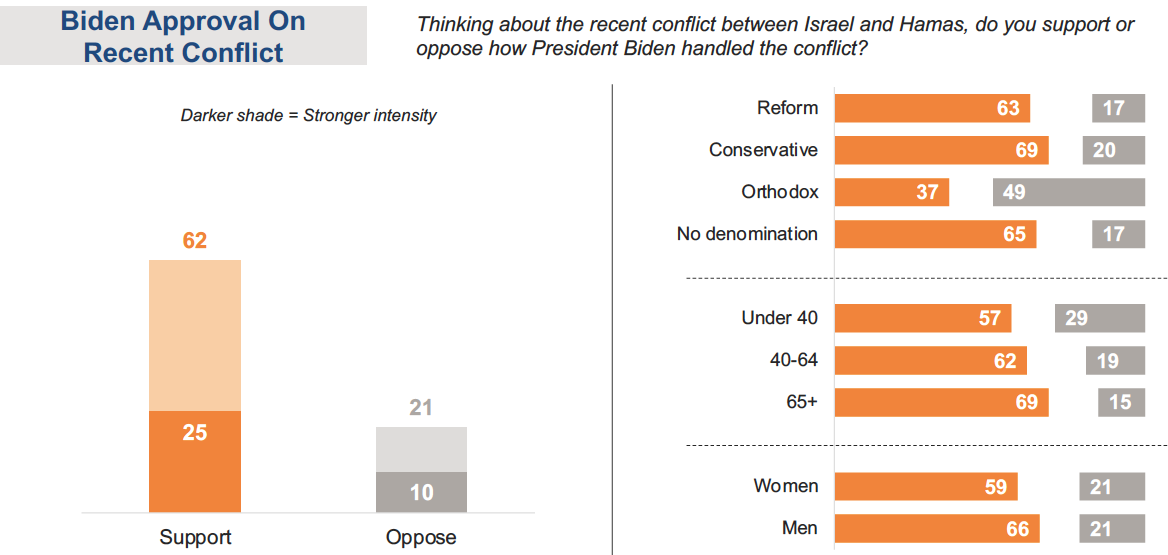
- B iden receives strong support for his handling of the recent conflict between Israel and Hamas, and Jewish voters support the Biden Administration restoring humanitarian aid to the Palestinians that had been cut by the Trump Administration. Majorities approve of how Biden handled the conflict (62 percent approve/21 percent disapprove) and support the renewal of aid to the Palestinians (62 percent support/28 percent oppose).
- There is widespread concern about antisemitism in the United States, spanning gender, age, and denomination. Nearly all Jewish voters are either very concerned (54 percent) or somewhat concerned (36 percent) about antisemitism.
- Most Jewish voters are more concerned about antisemitism originating from the right wing (61 percent) than from the left wing (22 percent).
- Intense criticism of Israel is generally not seen as antisemitic, unless it veers into denying Israel’s right to exist. Two-thirds believe that it is antisemitic to state that “Israel doesn’t have the right to exist,” compared to stating that “Israel is committing genocide against the Palestinians” (31 percent), “Israel is an apartheid state” (28 percent), and “Israel’s treatment of Palestinians is similar to racism in the U.S.” (20 percent). Only 26 percent believe that it is antisemitic to say that “Jews who vote Democratic are disloyal to Israel.”
- Voting rights is a high priority for Jewish voters, and they hold strong feelings about the current debate. It is the second most important issue cited, and 83 percent say they are concerned about the laws passed in Florida and Georgia.
- T here is strong support for federal legislation that would reverse the impact of the Florida and Georgia laws, and Jewish voters favor eliminating the filibuster to pass the federal legislation. Expanding voter access, setting a national standard for voting rights, and reversing the impact of Florida’s and Georgia’s laws receives 76 percent support; and 62 percent eliminating the filibuster to pass this legislation.
Demographic Data

Ideology and Partisanship

Congressional Vote
Thinking about the elections in 2022, if the general election for the U.S. Congress were being held today, for whom would you vote?

Favorability

Biden Job Approval
Do you approve or disapprove of the way Joe Biden is handling his job as president?

Biden Approval on Israel Relations
Do you approve or disapprove of the way Joe Biden is handling relations with Israel?

Approval of Biden’s Handling of Recent Israel-Hamas Conflict
Thinking about the recent conflict between Israel and Hamas, do you support or oppose how President Biden handled the conflict?

Issues Priority
Below is a list of issues facing our country today. Please mark which TWO of these issues you want President Joe Biden and Congress to focus on.

Attachment to Israel
How emotionally attached are you to Israel?

Being Critical of Israeli Government Policies
People often talk about being “pro-Israel”. Do you think someone can be critical of Israeli government policies and still be “pro-Israel”?

U.S. Aid to Israel
How important is it to you that the U.S. provide financial aid to Israel?

U.S. Aid to the Palestinians
Do you support or oppose the U.S. providing the same amount of financial aid that it gives Israel, but restricting it so that Israel cannot spend U.S. aid on expanding settlements in the West Bank?


Two States Vs. One State Options
In your opinion, which of the following would be the best resolution of the Israeli-Palestinian conflict?

Future of U.S. – Israel Relations
As you may know, Israel recently held an election that resulted in a new government, led by Naftali Bennett and Yair Lapid who will rotate as Prime Minister and replace Benjamin Netanyahu who served in this role for the past 12 years. Do you think the new government in Israel will strengthen or weaken relations between Israel and the United States, or will it make no difference?

Antisemitism
How concerned are you about antisemitism in the U.S.?

Antisemitism Concerns
Are you more concerned about antisemitism that originates from left-wing groups and individuals or antisemitism that originates from right-wing groups and individuals?


Jewish Safety
Overall, do you feel more safe, less safe, or no difference as a Jewish person living in America since Joe Biden became President?

Israel and Antisemitism
Below are some statements about Israel. For each one, do you agree or disagree with the statement? If you disagree, do you believe the statement is antisemitic or is not antisemitic?

Biden Vs. Trump Trust
(Split) For each of the following issues, please indicate whether you trust Joe Biden or Donald Trump to do a better job with this issue.

Party Trust
(Split) For each of the following issues, please indicate whether you trust Democrats in Congress or Republicans in Congress to do a better job with this issue.

Florida and Georgia Voting Laws
As you may know, Republican legislatures in Florida and Georgia have recently passed laws impacting access to voting and changing the way elections are conducted. Democrats say these laws target people of color and make it harder for them to vote. Republicans say these laws are necessary to stop election fraud and ensure election integrity. How concerned are you about the impact of these laws on our elections?

Federal Legislation on Voting Rights
Do you support or oppose federal legislation that would expand voter access, make a national standard for voting rights across the country, and reverse the impact of the new election laws passed by the Florida and Georgia legislatures?

Filibuster and Voting Rights
(IF SUPPORT) As you may know, the U.S. House of Representatives has passed legislation supported by President Biden that would reverse the impact of the new election laws passed by the Florida and Georgia legislatures, but the legislation does not have the 60 votes in the U.S. Senate to overcome a filibuster. Do you support or oppose eliminating the filibuster in order to pass this legislation?

Please contact press@jewishelectorateinstitute.org for any press inquiries.