National Survey of Likely Jewish Voters in 2020

February 28, 2020

On behalf of the non-partisan Jewish Electorate Institute (JEI), Garin-Hart-Yang conducted an online survey of 1,001 Jewish voters nationally who self-identify as Jewish and indicate that they are likely to vote in the November 2020 election.  The survey, which was conducted from February 18 to 24, 2020, has a margin of error of ±3.2 percentage points. JEI has conducted two other national surveys among Jewish voters (in 2018 and 2019), and it used the findings of those surveys to provide a baseline comparison of political preferences and views among the Jewish electorate.

Topline Analysis of the Data Regarding the Jewish Electorate

  • A majority of Jewish voters identify as Democrats, and an overwhelming majority of Jewish voters disapprove of President Trump.
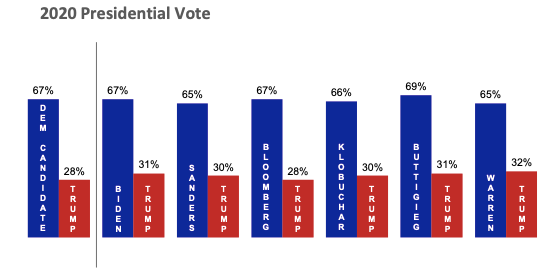
  • Jewish voters support each of the leading Democratic candidates at essentially the same level in head-to-head match-ups against Donald Trump.
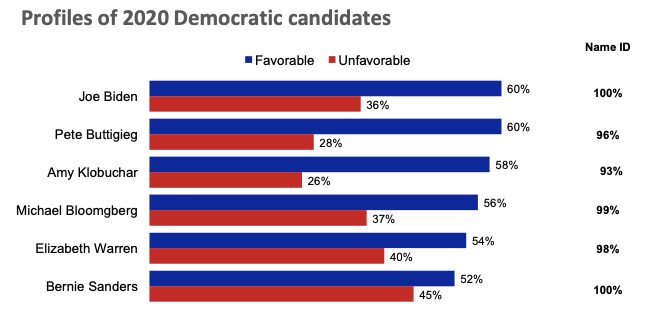
  • A majority of Jewish voters view all of the leading Democratic candidates favorably.
  • While Jewish voters remain strongly pro-Israel, Jewish voters prioritize domestic policy issues over Israel when asked which issues are most important to them in selecting a candidate.
  • While nearly all respondents identify as “pro-Israel,” a majority also identify as critical of at least some of the current Israeli government’s policies.
  • Jewish voters feel less secure than they did two years ago, and they hold President Trump responsible for their insecurity.
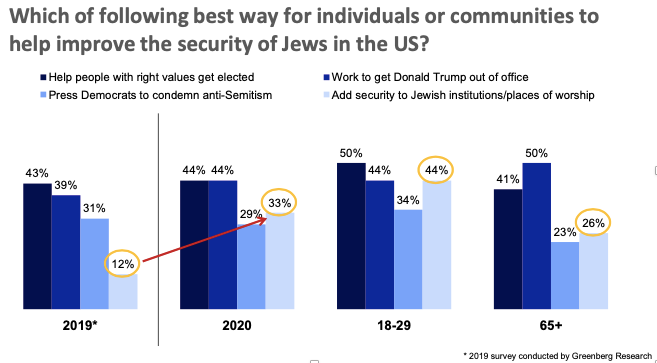
  • A plurality of Jewish voters believe that the best way to improve the security of Jews in the United States is “helping people with the right values get elected.”

This memorandum presents the 11 key findings of the JEI survey.

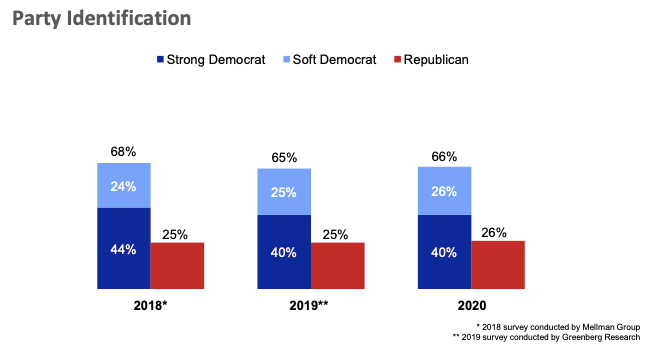
1.   A consistent majority of the Jewish electorate identify as Democrats. A consistent 25% of Jewish voters identify as Republicans, and a consistent +65% identify as Democrats. These numbers have not changed outside the margin of error since 2018.
2.   Jewish voters overwhelmingly disapprove of President Trump, with nearly three in five saying they strongly disapprove of Trump. These numbers have remained fairly consistent since he took office.
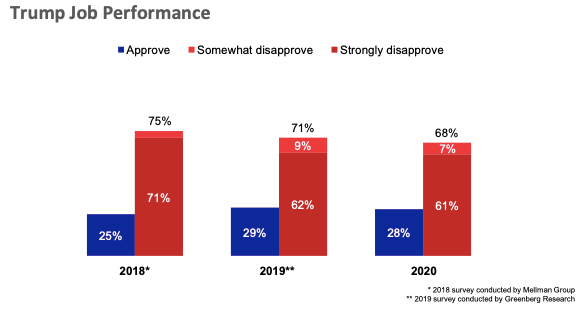
Jewish Democrats are overwhelmingly united against President Trump (6% approve, 93% disapprove), and while Jewish Republicans give President Trump more support (81% approve), 12% of Republicans say they disapprove.

3.   Jewish voters are generally supportive of all of the leading Democratic candidates at nearly equal levels . While Joe Biden and Pete Buttigieg lead the favorability rating with 60% each, Bernie Sanders ranked last, with more than half (52%) still viewing him favorably. Bernie Sanders’s unfavorable rating (45%) among Jewish voters is more than 20 points lower than President Trump’s (68%).
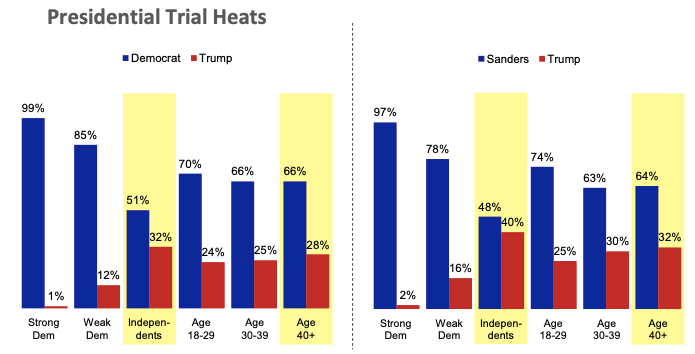
4.   Two-thirds of Jewish voters say they will vote for a generic Democratic candidate over President Trump in the 2020 general election. These numbers are similar to when Trump is pitted against any of the actual Democratic candidates.
5.   Despite uniform support for every Democratic candidate versus President Trump, Senator Bernie Sanders is a slightly more polarizing figure than his fellow Democratic candidates. Sanders has higher unfavorable ratings among some key subgroups, but he finds strong support among younger Jewish voters.
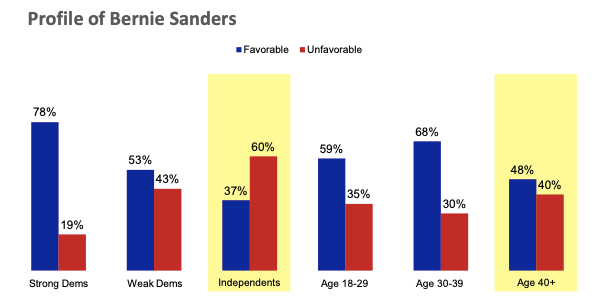
But, in keeping with Jewish voters’ overwhelming sentiment to vote out Trump, the Sanders vote in the trial heat looks fairly similar to the generic vote by these same subgroups:
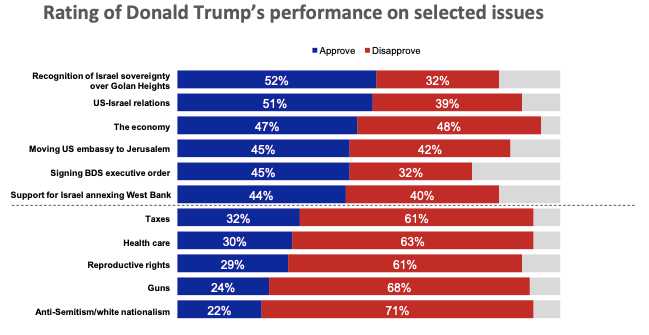
6 . While there are some issues for which President Trump’s performance is viewed as favorable by a majority or plurality of Jewish voters, this is not translating into support for him. The polling data on Donald Trump’s electoral prospects among Jewish voters suggest that the issues on which a slim majority of Jewish voters have a favorable view (namely, those related to Israel) are not driving the Jewish vote.
7. Domestic issues, particularly healthcare, Medicare, and Social Security, remain the top issues for Jewish voters.  When asked about the issues that are most important when selecting a candidate, Israel remains the lowest priority for Jewish voters. [1]
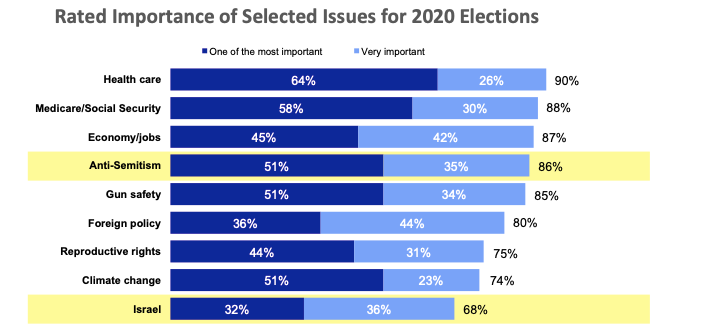

[1] These results are virtually identical to the 2019 polling, when we asked about Israel in a slightly different way: “How important will be a candidate’s position on Israel be for you personally in deciding who you will vote for in the November 2020 election?”
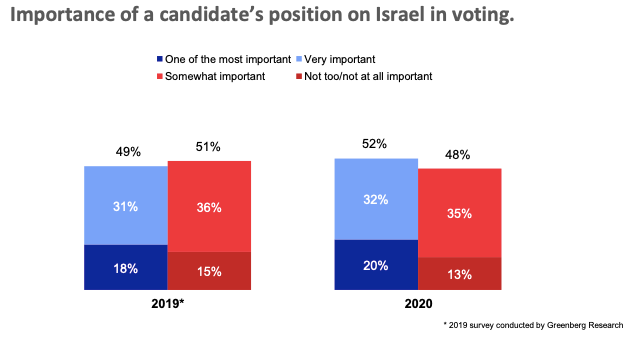
(Interestingly, there is little meaningful generational difference, as 21% of both Millennials and Jewish voters age 65 and older say that Israel is one of the most important issues to them.)

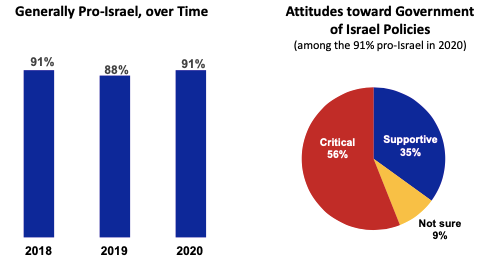
8. The low importance of Israel as a voting issue in 2020 does NOT mean a corresponding diminution of Jewish voters’ support for Israel.   A near universal 91% of respondents surveyed describe themselves as generally pro-Israel, which is at the same high level as in the 2019 and 2018 surveys.  While respondents are strongly pro-Israel, we find that 56% of the Jewish electorate are critical of at least some of the current Israel government’s policies.
9. A substantial proportion of Jewish voters personally feel less safe than they did two years ago, and they believe that Jews in the United States are less safe than they were two years ago.
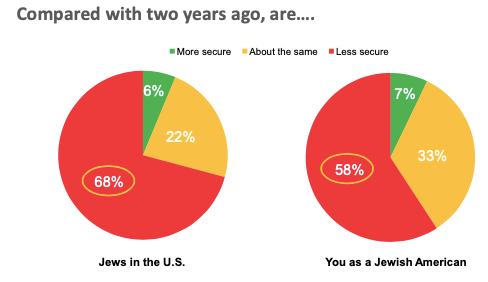
This is another finding in which there is little difference between demographic groups’ perceptions of insecurity in the Jewish community due to the rise of anti-Semitism: millennials feel less secure by 56% to 9%, which is not much different from voters age 65 and older (60% less secure, 3% more secure.)

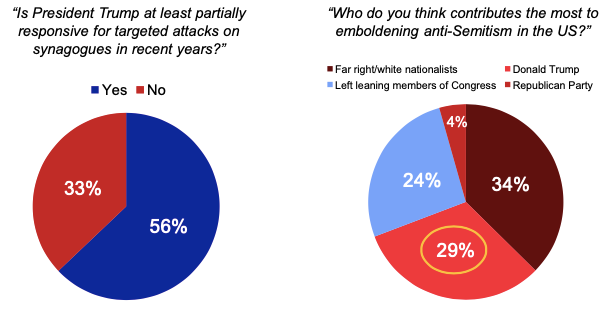
10. President Trump’s disapproval ratings for issues are highest when it comes to his handling of anti-Semitism and white nationalism (71% of voters disapprove, including one-third of Republicans.) President Trump is viewed by a significant percentage of Jewish voters as part of the problem fueling the rise of anti-Semitism.

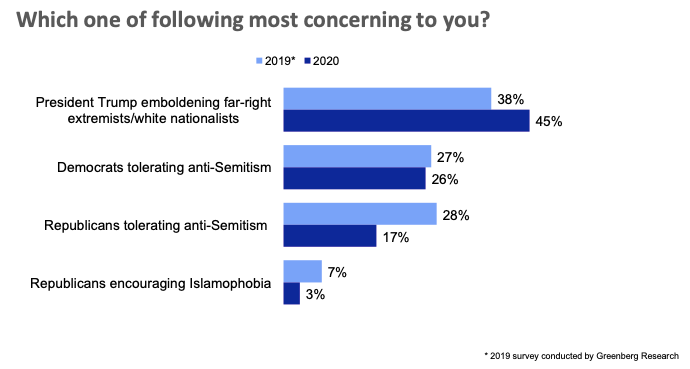
A plurality (45%) express concern about President Trump’s emboldening far-right extremists and white nationalists, a notable change since 2019.  More than one in four Republican voters express concern about Trump’s actions and about “Republicans tolerating anti-Semitism” in their ranks:
Similarly, President Trump and the GOP are viewed to some extent as contributing to rising anti-Semitism, and 56% of Jewish voters believe he is at least partially to blame for targeted attacks on synagogues:
11.   Jewish voters continue to channel their concern about issues, such as rising anti-Semitism, into political action , with virtually similar results by key demographics such as age, with a plurality of voters indicating that the best way to improve Jews’ security in the United States is by “helping people with the right values get elected.”

April 15, 2026
U.S. JEWS VOTING DEM IN CONGRESS MIDTERMS YET QUESTION WHAT PARTY STANDS FOR, ESP. ON ISRAEL JEWISH R ’ s MOST ID ’ d AS PRO-ISRAEL, NEW POLL SHOWS United in Support of Israel ’ s Right to Exist as Jewish Homeland But Mixed Concepts of Zionism Jews see too much Israel criticism playing into antisemitism While most Jews feel too many Israel supporters use antisemitism claims to avoid legitimate policy debate WASHINGTON – The latest Jewish Electorate Institute (JEI) poll shows American Jews are voting heavily Democratic in the midterm election for Congress. At the same time, Jews have questions about what the Democratic Party stands for, particularly on Israel. Jewish Republicans, on the other hand, are most identified as being pro-Israel, which is also one of their biggest image advantages over Democrats. Meanwhile, amid debates in the Jewish community over Israel, war in Iran and election politics, American Jews are united in support of Israel’s right to exist as a Jewish state and homeland for the Jewish people. However, there are mixed signals over the concept of Zionism, with the majority seeing Zionism favorably, but only a third calling themselves Zionists. There is also concern about how antisemitism is becoming a part of the increasingly heated discussions over U.S.-Israel issues, by both sides. A large majority of U.S. Jews see too many critics of Israel using language about Jews that play into antisemitism, whether intended or not. At the same time, a majority of Jews feel too many supporters of Israel use claims of antisemitism to avoid legitimate debate over policy. These analyses are based on the final release of the findings of a national survey of 800 Jewish registered voters, with an oversample to yield 600 Jewish women. The survey was conducted for JEI by The Mellman Group using a high-quality online national panel from March 13-23, 2026. The margin of error for the sample as a whole is +/- 3.5% at the 95% level of confidence (higher for subgroups). Previous JEI analyses and releases centered on U.S. Jews’ pro-Israel identity and their criticism of the government, support for pro-Israel spending in the primaries and the popularity of AIPAC, DMFI and J Street. Also, on what American Jews would likely discuss at the Passover seder tables.
April 15, 2026
Jewish Voters Highly Engaged, Prioritize Domestic Issues; Strong Support for Israel and Caution on Military Action and Advocacy This recent March 2026 national survey finds that American Jewish adults overwhelmingly affirm Israel’s right to exist while also expressing caution about the current U.S. military escalation in Iran. Views on pro-Israel political spending, however, remain mixed. AIPAC has an overall favorable impression of 39%, DMFI 32%, and J Street 18%. Some key findings also include the following: Turnout and partisanship: Registered respondents report their very high intention to turn out for the November 2026 midterm elections. About seven in ten identify as Democrats (many strongly), roughly one in four compared to Republicans, with the remainder being made up of Independents. Democrats hold a substantial advantage in hypothetical congressional votes in respondents’ districts. Donald Trump receives broad net disapproval, and Benjamin Netanyahu is viewed unfavorably by more respondents than favorably. Israel and Zionism: There are mixed signals over the concept of Zionism, with the majority seeing Zionism favorably, but only a third calling themselves Zionists. Roughly seven in ten hold a favorable view of Israel; 87% endorse Israel’s right to exist as a Jewish homeland. Most see Zionism as Jewish self‑determination, though only a third self‑identify as Zionist. A surprisingly large number are unsure about the definition of Zionism. Foreign policy and military action: A majority of respondents oppose current U.S. military action against Iran and say the president should have sought congressional approval for strikes. Many prioritize preventing Iran from obtaining nuclear weapons but favor clear objectives and oversight over unilateral escalation. 2026 Midterm Elections & Party Affiliations: American Jews are voting heavily Democratic in the midterm election for Congress. At the same time, Jews have questions about what the Democratic Party stands for, particularly on Israel. Jewish Republicans are most identified as pro-Israel, which is one of their biggest image advantages over Democrats. Pro‑Israel advocacy and spending: Opinions are split on outside groups spending in primaries—about a third support such spending, a third oppose it, and many are undecided. Respondents are nearly evenly divided on whether aggressive outside intervention helps or harms U.S.–Israel relations. Antisemitism and public debate: A large majority say some criticism of Israel slips into antisemitic tropes, and a significant share also believes some defenders wrongly label policy criticism as antisemitism. There is also concern about how antisemitism is becoming a part of the increasingly heated discussions over U.S.-Israel issues, by both sides. A large majority of U.S. Jews see too many critics of Israel using language about Jews that plays into antisemitism, whether intended or not. At the same time, a majority of Jews feel too many supporters of Israel use claims of antisemitism to avoid legitimate debate over policy. Domestic Issues are Important: Democrats are viewed positively on healthcare, abortion rights, fair elections, and middle class advocacy, while Republicans are viewed as pro-Israel but excessively conservative and unwilling to oppose the President. The sample of respondents: The current distribution of Jewish voters by party affiliation: 69% Democratic, 24% Republican, and 7% Independent. Poll respondents are mixed gender, highly educated, and religiously plural within Judaism (Reform and unaffiliated are the largest). About one‑third belong to a synagogue, but religious practice varies. Jewish women Voters: There are more female Democrats likely to hold reinforcing views, contributing to the party's electoral advantage, thereby fueling the midterm margin. The partisan divide is even larger among women. Nearly three-quarters (74%) of Jewish women identify as Democrats, including 50% who are strong Democrats, and 24% who identify as Democratic Socialists. Likely Jewish women voters are supporting the Democrats in the generic vote: 78% Democratic, 19% Republican, and only 3% undecided. The Democratic vote margin increases significantly with age among Jewish women. Women ages 18-29 vote +46 Democratic, rising to +60 among those 40–59 and +58 among those 60 and older. These margins exceed those of the overall Jewish electorate, where voters ages 40–59 and 60+ both register a +48 Democratic advantage. The strength of Jewish identity also follows a consistent pattern. Among women who place lower importance on being Jewish, the Democratic advantage is +74, compared to +61 among the overall electorate. Among those who place higher importance on being Jewish, Jewish women still lean more Democratic than the overall electorate, at +41 versus +36. Jewish women are also more likely to disapprove of Trump’s job performance and the current U.S. military action against Iran. They are four points more likely than the overall electorate to disapprove of Trump’s job performance (77% vs. 73%) and the U.S. military action in Iran (59% vs. 55%). Jewish voters combine strong civic engagement and a clear Democratic preference with nuanced views that favor protecting Israel while insisting on democratic oversight, strategic clarity, and careful political tactics. Well-positioned issues that resonate for candidates and organizations in the upcoming 2026 midterm elections include emphasizing support for Israel alongside respect for congressional authority, clear policy goals, and sensitive messaging on antisemitism. "This poll reinforces a simple truth that the Jewish community is not monolithic, and the Jewish vote should not be taken for granted. Their concerns extend beyond Israel and Iran. It also indicates a critical need for education about Israel's history and the meaning of Zionism. These needs have never been more urgent than they are today," said Barbara Goldberg Goldman, JEI Chair. These analyses are based on the final release of the findings of a national survey of 800 Jewish registered voters, with an oversample to yield 600 Jewish women. The survey was conducted for JEI by The Mellman Group using a high-quality online national panel from March 13-23, 2026. The margin of error for the sample as a whole is +/- 3.5% at the 95% level of confidence (higher for subgroups).
April 14, 2026
The survey was released one week after another conducted by the Mellman Group and commissioned by the Jewish Electorate Institute found that a majority of American Jews have “not heard much” about the role that pro-Israel lobbying groups have played in this year’s early midterm primaries.  The poll, which surveyed 800 registered Jewish voters March 13-23, found that just 11% of American Jews had heard a “great deal” about “the role pro-Israel groups have played in the early 2026 primaries,” while 27% said they’d heard “some” about it. Meanwhile, 62% said they’d either heard “not much,” “none at all” or that they don’t know.