Press Releases

FOR IMMEDIATE RELEASE September 17, 2026 CONTACT: Steve Rabinowitz steve@bluelightstrategies.com c: (202) 265-3000 MAJORITY OF U.S. JEWS CONCERNED NETANYAHU HAS INCREASED ANTISEMITSM, NEW POLL SHOWS; Also Highlights Divisions On Aid, AIPAC and the Primaries Washington, DC – American Jews are still overwhelmingly pro-Israel but also very critical of Israel and Prime Minister Netanyahu, according to a new survey by the Mellman Group for the Jewish Electorate Institute. A majority are concerned that Netanyahu’s actions have increased antisemitic and anti-Israel sentiment. While this is more prevalent among Democrats, even a third of GOP Jews are greatly concerned. This poll also shows the divisions on some recent hot button issues. For instance, most Democrats support cutting aid to Israel, while majorities of independents and Republicans are opposed. There is also a division on the recent pro-Israel action in primary elections – with over a third of Jews feeling it has made things worse, while an increasing plurality feel it is more important than ever. Jews Are Pro-Israel but Very Critical of Netanyahu, Though Not Focused on The Upcoming Israeli Election An overwhelming 86% of American Jews identify themselves as Pro-Israel, including 65% saying they are pro-Israel but critical of some or many of Israeli government policies. This is barely changed from the March JEI poll which showed 86% pro-Israel and 63% critical. Nearly three quarters (71%) see Israel favorably compared to 25% unfavorably – also barely changed from March (71%/24%). At the same time, 61% have an unfavorable view of Netanyahu, with 34% favorable. This is within a point of Netanyahu’s standing from the JEI post-election poll in November 2024 which showed 33% favorable, 61% unfavorable. While 80% of American Jews are following the November elections in the U.S., only 38% are following the October elections in Israel. They do, however, have a strong preference in the outcome with 60% wanting Netanyahu replaced, including 53% feeling strongly. Only 16% of American Jews want to see him reelected. A Majority Are Concerned Netanyahu Has Increased Anti-Semitic And Anti-Israel Feelings Nearly half of American Jews are concerned about antisemitic rhetoric in the Republican Party (48% a great deal of concern) and Democratic Party (44%). Even among partisans, roughly three in ten are greatly concerned about antisemitic rhetoric within their own party, with 29% of Republicans saying that about the GOP and 34% of Democrats saying it about their party. A 56% majority of Jews have a great deal of concern that “Israel’s actions under Netanyahu have increased antisemitism and anti-Israel sentiment in the U.S.” Two thirds (65%) of Democratic Jews feel this way, and nearly half (46%) of independents and a third (34%) of Republicans. Most Democrats Would Cut Aid To Israel, But Republicans & Independents Are Opposed A 52% majority of Jews support cutting or eliminating aid to Israel, with 17% supporting “eliminating all $3.3 billion in military aid that the U.S. provides Israel” and 36% preferring to cut but not eliminate aid. Four in ten (40%) would keep aid at current levels, with 8% not sure. There are stark differences on partisanship, with nearly two thirds of Democrats (63%) wanting to cut or eliminate aid, and a similar two thirds of Republicans (67%) and independents (65%) for keeping current levels. Four in ten (40%) Jews are concerned about Congressional support for eliminating aid for “defensive weapons like Iron Dome” (40%), only slightly higher than concern for eliminating “offensive weapons” (36%). A majority of Republicans are concerned about cuts to either offensive (54%) or defensive weapon (56%), while less than half of independents are concerned (44% defensive, 45% offensive) and only a third of Democrats (34% defensive, 29% offensive.) Still, there is more of a cost for a Member of Congress voting to cut aid, than a benefit. Nearly half (47%) are less likely to support a Member voting to cut aid, including 36% of those who support cutting aid themselves. Only one in five (21%) are more likely to vote for a Member cutting aid. Even among those who support cuts, only 13% are more likely to support a Member voting that way. Views On AIPAC And The Recent Primary Battles Are Mixed, Even Among Democrats A majority (51%) of American Jews have heard at least something about pro-Israel activity in this year’s primary elections – up from 38% in March. However, higher awareness has not dramatically changed opinions. A narrow 39% plurality support the pro-Israel activity in the primaries, 35% oppose it, and 26% are unsure; very similar to March (37% support, 32% oppose, 31% not sure). Given a choice between two statements, 45% believe “With increasing anti-Israel sentiment and threats to Israel, it is more important than ever for pro-Israel groups to play an active role against candidates who are not supportive enough of a strong US-Israel relationship”, while 37% believe that “These heavy-handed efforts by pro-Israel groups in primary elections make things worse by turning voters against a strong US-Israel relationship, and they should stop.” Large majorities of Republicans and independents believe it more important than ever for pro-Israel groups to get involved in the primaries. But while Democrats lean the other way, they are more torn – with 46% saying the pro-Israel activity is making things worse, but the majority of Democrats either think it’s more important than ever (34%) or are not sure (20%). Indeed, views of AIPAC, the biggest pro-Israel spender in primaries, are mixed, with 42% favorable, 35% unfavorable, and 24% not sure. AIPAC is seen favorably by most independents (55% favorable, 15% unfavorable) and Republicans (71% favorable, 12% unfavorable). Jewish Democrats are 44% unfavorable, with a majority either favorable (31%) or not sure (25%). Moreover, Democratic Jews do not fit easily into one box on AIPAC. Nearly half (45%) agree with the statement “AIPAC is being unfairly singled out for doing just what other advocacy groups do”. Yet 30% agree they cannot vote for a candidate who accepts money from AIPAC, while 19% cannot support a candidate who refuses money from AIPAC. “While American Jews are generally together on being pro-Israel even if critical of the government, there are divisions on what should be done in the U.S. on aid and elections,” says Michael Bloomfield, Executive V.P. and Managing Director of The Mellman Group, which conducted the survey for JEI. Meanwhile, despite all the recent coverage of socialist candidates and antisemitism, Jews are still voting overwhelmingly Democratic in the generic vote for Congress, the new survey shows. However, this poll also shows that Jewish Democrats have concerns about their party. Over a third of Jewish Democrats say anti-Israel candidates are making it harder to identify as Democrats. So far, this is not affecting their vote, but this poll shows crosscurrents under the surface and the potential for fissures. Jews Overwhelmingly Support Democrats in the Generic Congressional Vote Two months from the midterm elections, Democrats have a 71%-23% lead among Jews in the generic vote for Congress; barely changed from 71%-24% in our March JEI poll. Jewish Democrats are almost totally consolidated with 97% voting Democratic. Democrats also have a 14-point lead among Jewish independents (35%-21%), though the plurality (43%) is undecided. Democrats’ 48-point margin among Jewish voters is within the historical range in recent exit polls, nearly matching 2024’s 50-point margin and exceeding the 33-point Democratic margin in 2022, though it falls short of the 64-point margin in the last blue wave election in 2018. Moreover, Jews view the Democratic Party significantly more favorably (59%) than the GOP (24%), in line with the large Democratic advantage in party ID (68% identifying as Democrats compared to 22% Republican). In fact, net favorability for the Democratic Party has increased slightly (+2) since March, while net favorability for Republican Party has dropped (-3). Jews also give Democrats significant advantages on representing their point of view (57% Democrats, 23% Republicans), shared values (61% Democrats, 22% Republicans), and fighting antisemitism (37% Democrats, 27% Republicans, though neither party gets high marks on this dimension). Jews are also more likely to see Republicans as too extreme (70% Republicans, 33% Democrats). The Mellman Group (September 2026) Still, Jewish Democrats Have Concerns About Their Party Despite this overwhelming Democratic support, Jews and Democratic Jews have concerns about recent trends in the Party. These concerns revolve around three areas: Antisemitism: A 57% majority believe antisemitism is increasing in the Democratic Party; and 60% see antisemitism increasing in the GOP. But only 37% of Republican Jews say it is rising in their ranks compared to 50% of Jewish Democrats seeing the increase in their party. Only 37% say that “fighting antisemitism” describes Democrats, a 5 point drop just from March. Nearly half (46%) of Jewish Democrats would not describe Democrats as fighting antisemitism. Israel: A 51% majority do not think “pro-Israel” describes Democrats. This is 6-point increase from March (45%) and a 15-point increase from 2018 (36%). Over a third (35%) of Jewish Democrats agree: “The rise of anti-Israel candidates in the Democratic Party is making it harder for you personally to identify as a Democrat. Half (50%) of Jewish Democrats say they cannot support candidates accusing Israel of genocide. Socialism: Views of democratic socialism are mixed with 44% favorable and 43% unfavorable; but more negative on Democratic Socialists of America at 35% favorable, 45% unfavorable. Jewish Democrats are majority favorable about both democratic socialism (60% favorable, 28% unfavorable) and the DSA (47% favorable, 29% unfavorable). Two-thirds of Democratic Jews (65%) are open to voting for democratic socialists, and 72% if it means Democratic control of Congress. On the flip side, 25% of Democrats say they are not open to socialists, with 15% not open even if control of Congress is at stake. The range of views within the community is reflected in views of New York City Mayor Zohran Mamdani and Michigan Senate Candidate Abdul El-Sayed. Jews overall are slightly net unfavorable about both Mamdani (44% favorable, 45% unfavorable) and El-Sayed (33% favorable, 37% unfavorable, 30% don’t know.) But among Democratic Jews, both are seen favorably, with Mamdani 2:1 favorable (60% to 29%) and El-Sayed at 44% favorable, 23% unfavorable, though a third of Jewish Democrats don’t know El-Sayed well enough to have an opinion. “People can hold contradictory attitudes,” says Bloomfield, the pollster. “Right now, whatever their concerns, Jews are overwhelmingly voting Democratic; and see Democrats as more in line with their views and values than Republicans. But concerns about the Democratic party – as well as the GOP – are clear, even among Jewish Democrats. Whether or not this affects the vote in the midterms, these cross-pressures will certainly be factors going well beyond this November,” Bloomfield says. “Preliminary findings and analyses raise some red flags that should not be ignored,” says JEI chair Barbara Goldberg Goldman. “Several glaring red flags cannot be discounted. For example, among Jewish Republicans and especially among Democrats, there is concern about how their respective parties are recognizing and addressing the exponential rise in antisemitism. Although Democratic and Republican voters’ support for their respective parties appears steady today, Israel, Socialism and antisemitism are significant issues,” Goldberg Goldman says. “While vote totals may shift modestly today, these results very well could be serious indicators of future trends, and very well could be a blueprint for what lies ahead for Jewish voters.” This analysis is based on the findings of a national survey of 800 Jewish registered voters by the Mellman Group for JEI. The survey was conducted using a high-quality online national panel from August 25-September 3, 2026. The margin of error for the sample as a whole is +/- 3.5% at the 95% level of confidence (higher for subgroups). The Mellman Group Named “Pollster of the Year” three times by the American Association of Political Consultants, The Mellman Group has provided sophisticated opinion research and strategic advice to political leaders, public interest organizations, Fortune 500 companies, and government agencies for over 30 years. All told, The Mellman Group has helped win over fifty senate and gubernatorial races, and nearly one hundred House race contests. More at https://mellmangroup.com/ . Jewish Electorate Institute JEI is the foremost resource on Jewish voter political preferences, producing the top research, polling, and analysis critical to understanding the Jewish electorate. The nonpartisan nonprofit was founded in 2017 and became independent in 2024. See https://www.jewishelectorateinstitute.org/ for more. For more media information, contact board member Steve Rabinowitz at 202-265-3000 or steve@bluelightstrategies.com.

U.S. JEWS VOTING DEM IN CONGRESS MIDTERMS YET QUESTION WHAT PARTY STANDS FOR, ESP. ON ISRAEL JEWISH R ’ s MOST ID ’ d AS PRO-ISRAEL, NEW POLL SHOWS United in Support of Israel ’ s Right to Exist as Jewish Homeland But Mixed Concepts of Zionism Jews see too much Israel criticism playing into antisemitism While most Jews feel too many Israel supporters use antisemitism claims to avoid legitimate policy debate WASHINGTON – The latest Jewish Electorate Institute (JEI) poll shows American Jews are voting heavily Democratic in the midterm election for Congress. At the same time, Jews have questions about what the Democratic Party stands for, particularly on Israel. Jewish Republicans, on the other hand, are most identified as being pro-Israel, which is also one of their biggest image advantages over Democrats. Meanwhile, amid debates in the Jewish community over Israel, war in Iran and election politics, American Jews are united in support of Israel’s right to exist as a Jewish state and homeland for the Jewish people. However, there are mixed signals over the concept of Zionism, with the majority seeing Zionism favorably, but only a third calling themselves Zionists. There is also concern about how antisemitism is becoming a part of the increasingly heated discussions over U.S.-Israel issues, by both sides. A large majority of U.S. Jews see too many critics of Israel using language about Jews that play into antisemitism, whether intended or not. At the same time, a majority of Jews feel too many supporters of Israel use claims of antisemitism to avoid legitimate debate over policy. These analyses are based on the final release of the findings of a national survey of 800 Jewish registered voters, with an oversample to yield 600 Jewish women. The survey was conducted for JEI by The Mellman Group using a high-quality online national panel from March 13-23, 2026. The margin of error for the sample as a whole is +/- 3.5% at the 95% level of confidence (higher for subgroups). Previous JEI analyses and releases centered on U.S. Jews’ pro-Israel identity and their criticism of the government, support for pro-Israel spending in the primaries and the popularity of AIPAC, DMFI and J Street. Also, on what American Jews would likely discuss at the Passover seder tables.
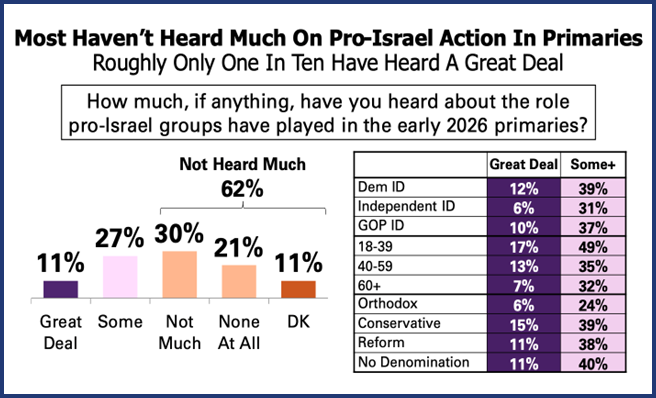
FOR IMMEDIATE RELEASE MEDIA CONTACT: info@jewishelectorateinstitute.org TUESDAY, APRIL 7, 2026 202-695-0531 U.S. JEWS IDENTIFY AS BOTH PRO-ISRAEL & CRITICAL OF ITS GOV’T Jewish Repub’s, Indi’s Support Pro-Israel Spending in Primaries; Dems Less So AIPAC popular among R’s, not as much among D’s; DMFI better liked by D’s WASHINGTON – As the Democratic National Committee sets to convene in New Orleans this week and consider resolutions on Israel and its AIPAC lobby, a new poll for the Jewish Electorate Institute (JEI) finds the majority of American Jews identifies as both pro-Israel and critical of the Israeli Government. There is limited awareness of the spending by pro-Israel groups in the 2026 primaries, with only one in ten saying they have heard a great deal about it. Attitudes split on partisan lines with majorities of independent and Republican Jews supporting this spending, while a plurality of Democrats is opposed. But still, the majority of Democrats are either not sure or supportive, the poll finds. These are among the top findings of a survey of registered Jews nationally for the JEI by The Mellman Group, several others of which were released last week before Passover. A fuller release of all its findings will come on Friday, after the holiday ends. Further, attitudes about AIPAC and DMFI, the pro-Israel groups spending the most in these primaries, are also split on partisan lines, with AIPAC slightly underwater among Democrats, and popular among Republicans. DMFI is less known but better liked among Democrats. J Street’s numbers are relatively even but measurably smaller. This analysis is based on the findings of a survey of 800 registered Jewish voters nationally. The survey was conducted for JEI by The Mellman Group using a high-quality online national panel from March 13-23, 2026. The margin of error for the sample as a whole is +/-3.5% at the 95% level of confidence (higher for subgroups). Majority of U.S. Jews Identifies as Both Pro-Israel and Critical of Israeli Policies An overwhelming 86% of American Jews describe themselves as generally pro-Israel. However, fewer than one-quarter (23%) say they are both pro-Israel and supportive of Israeli policies. A 63% majority identifies as pro-Israel and critical of the Israeli government policies – split roughly equally between those who are critical of some policies (32%) and those critical of many (31%). Just a combined 14% say they are not generally pro-Israel (9%) or do not hold a view (5%). This trend is not dissimilar to one in the JEI poll that shows Jews are also generally patriotic towards America but also critical of some government policies, numbers for which will be released Friday. While pro-Israel sentiment extends across party (84% of Democrats, 90% of independents, 94% of Republicans), Democrats are considerably more likely to be critical of Israeli policies (73% critical) than independents (44%) and Republicans (39%).
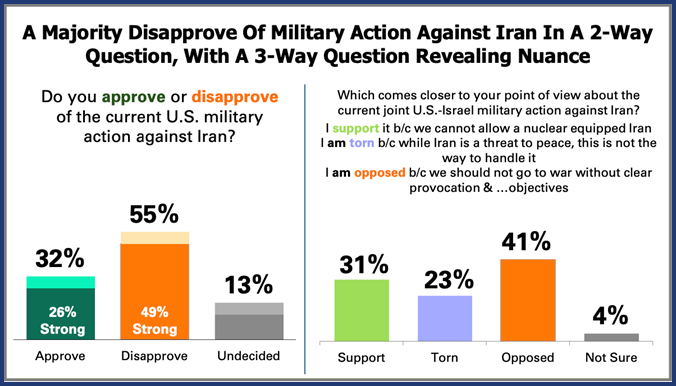
EMBARGOED FOR RELEASE CONTACT: Monday, March 30, 2026, 07:00 am info@jewishelectorateinstitute.org 202-695-0531 AMERICAN JEWS EXPECT TO DISCUSS IRAN WAR, ANTISEMITISM AT PASSOVER SEDER TABLES, AMONG FOUR NEW QUESTIONS, POLL SAYS Majority Oppose the War, One-Third Support It, Some Feel Torn Nearly 3/4 Say Trump Needed Congress’ Approval Washington, DC – A new survey of American Jewish opinion, on the eve of the Passover holiday, shows the majority of American Jews expect the Iran war to be a topic at Seder this week. One-third of Jewish voters approve of the war, with a majority disapproving, and some feeling torn. Nearly three-quarters feel President Trump should have sought Congressional approval beforehand. There are also concerns about the long-term impact of the U.S. and Israel conducting this as a joint operation. The poll of 800 registered American Jewish voters nationally, 88% of whom say they will almost certainly or very likely vote in the November 2026 general election for Congress, were surveyed online by the Mellman Group from March 13th-23rd for the Jewish Electorate Institute (JEI), a nonprofit which enjoys an extensive record of survey research of the American Jewish community. Those polled indicated the war with Iran and antisemitism in America are the two topics most likely to come up at Seder or other Passover gatherings this week, with hate crimes in the U.S. and the topic of Gaza and the Palestinians trailing behind. Most Expect the War, Antisemitism to Be Topics at Seder Asked how likely these “four questions” were to come up at Seder this week, a 60% majority said the war was very likely to be discussed, including 31% saying it was almost certain to come up. This majority extended across party, age, Jewish denomination, and strength of Jewish identification. A slightly smaller 56% majority feels it is very likely that antisemitism in the U.S. will also be such a frequent topic of Passover discussion this year, while hate crimes in the U.S. (at 43%) and the issue of Gaza and the Palestinians (at 40%) lag among the four questions. The survey was conducted using a high-quality online national panel from March 13th-23rd, 2026. The margin of error for the sample as a whole is +/-3.5% at the 95% level of confidence (higher for subgroups). It was part of a larger poll, the results of which JEI will be releasing in the coming weeks.