AMERICAN JEWS EXPECT TO DISCUSS IRAN WAR, ANTISEMITISM AT PASSOVER SEDER TABLES, AMONG FOUR NEW QUESTIONS, POLL SAYS
EMBARGOED FOR RELEASE CONTACT:
Monday, March 30, 2026, 07:00 am info@jewishelectorateinstitute.org
202-695-0531
AMERICAN JEWS EXPECT TO DISCUSS IRAN WAR, ANTISEMITISM AT PASSOVER SEDER TABLES, AMONG FOUR NEW QUESTIONS, POLL SAYS
Majority Oppose the War, One-Third Support It, Some Feel Torn
Nearly 3/4 Say Trump Needed Congress’ Approval
Washington, DC – A new survey of American Jewish opinion, on the eve of the Passover holiday, shows the majority of American Jews expect the Iran war to be a topic at Seder this week. One-third of Jewish voters approve of the war, with a majority disapproving, and some feeling torn. Nearly three-quarters feel President Trump should have sought Congressional approval beforehand. There are also concerns about the long-term impact of the U.S. and Israel conducting this as a joint operation.
The poll of 800 registered American Jewish voters nationally, 88% of whom say they will almost certainly or very likely vote in the November 2026 general election for Congress, were surveyed online by the Mellman Group from March 13th-23rd for the Jewish Electorate Institute (JEI), a nonprofit which enjoys an extensive record of survey research of the American Jewish community.
Those polled indicated the war with Iran and antisemitism in America are the two topics most likely to come up at Seder or other Passover gatherings this week, with hate crimes in the U.S. and the topic of Gaza and the Palestinians trailing behind.
Most Expect the War, Antisemitism to Be Topics at Seder
Asked how likely these “four questions” were to come up at Seder this week, a 60% majority said the war was very likely to be discussed, including 31% saying it was almost certain to come up. This majority extended across party, age, Jewish denomination, and strength of Jewish identification.
A slightly smaller 56% majority feels it is very likely that antisemitism in the U.S. will also be such a frequent topic of Passover discussion this year, while hate crimes in the U.S. (at 43%) and the issue of Gaza and the Palestinians (at 40%) lag among the four questions.
The survey was conducted using a high-quality online national panel from March 13th-23rd, 2026. The margin of error for the sample as a whole is +/-3.5% at the 95% level of confidence (higher for subgroups). It was part of a larger poll, the results of which JEI will be releasing in the coming weeks.
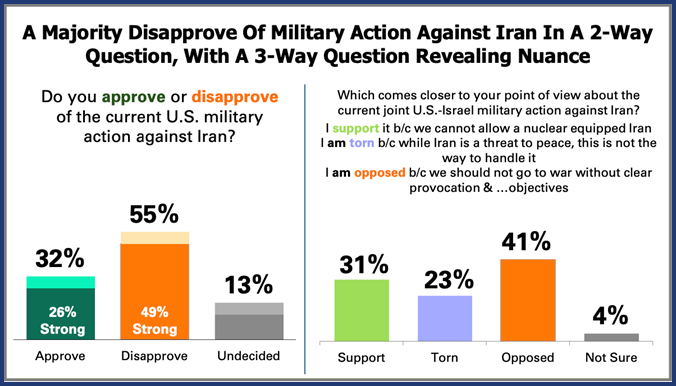
A Majority Disapproves of Military Action Against Iran, with Some Torn
A 55% majority disapproves of the U.S. action against Iran, compared to 32% who approve. Feelings are intense, with nearly 49% disapproving strongly, and 26% approving strongly. There is a clear partisan divide, with 74% of Jewish Democrats disapproving and 83% of Republicans approving. There is also a split by denomination – with 83% of Orthodox approving, while a plurality of Conservative movement Jews disapproves (48%) and majority disapproval among Reform (67%) and self-described non-denominational (56%) Jews.
Jewish men are more supportive of the war than women. Women disapprove by a more than 2:1 majority (26% approve, 59% disapprove), while it is a closer split among men (40% approve, 49% disapprove). Given three choices, nearly one-third (31%) say they “support the war because we cannot allow a nuclear equipped Iran.” On the other end of the spectrum, 41% say they are “opposed because we should not go to war without clear provocation and clear objectives.” And nearly one-in-four American Jews (23%) say that they are “torn because while Iran is a threat to peace, this is not the way to handle it”.
Among Jewish Democrats, 28% feel torn. Among all those who disapprove of the war, 24% said they feel torn. And, among the 14% who weren’t sure on the initial approval/disapproval question, over half of them (53%) say they feel torn.
A Larger 3:1 Majority Believe Trump Should Have Sought Congressional Approval
Nearly three-quarters (73%) say President Trump should have sought Congressional approval before launching military strikes on Iran, compared to only 22% who believe he was right to act without Congress. And even among those supporting the war, 29% believe Trump should have gone to Congress, including 22% of Republicans and 30% of the Orthodox.
A Majority is Worried that Conducting the War Jointly with Israel Could be a Long-Term Problem Prompting Concerns About the Role of Jews in U.S. Foreign Policy
Nearly one-third (32%) believes joint operations are a “good thing because it will be a more effective operation and more likely to accomplish shared goals.” But 54% believe that joint operations are “bad because it will be a long-term problem prompting concerns about the role of Israel and American Jews in U.S. foreign policy.” This concern is highest among Democrats (70%) and those against the war (83%).
Supporters of the war are also more positive about joint operations, with overwhelming
majorities seeing it as good (81%) rather than bad (12%). But there is still some concern even among Republican Jews (79% good, 15% bad) and Orthodox Jews (74% good, 21% bad).
As noted near the top here, this is the first release from this new poll. More to come soon.
Named “Pollster of the Year” three times by the American Association of Political Consultants, The Mellman Group has provided sophisticated opinion research and strategic advice to political leaders, public interest organizations, Fortune 500 companies, and government agencies for over 30 years. All told, The Mellman Group has helped win over fifty senate and gubernatorial races, and nearly one hundred House race contests.
Mellman Executive Vice President Michael Bloomfield observed, “These results are a reminder that American Jews are not monolithic. There can be difference, and in this case strongly held on both sides, with a middle group torn between mixed feelings. In today’s political environment, partisanship is a very strong driver of views. That is true across the country across demographics, including American Jews.”
JEI is the foremost resource on Jewish voter political preferences, producing the top research, polling, and analysis critical to understanding the Jewish electorate. Chair Barbara Goldberg Goldman said, “American Jews are deeply concerned by the direction of our Country, the latest JEI poll says. The exponential and ongoing rise in violent antisemitism and hate crimes now occurring during an unpopular war is causing Jewish Americans to feel less safe. As we approach the 250th anniversary of American democracy, the Jewish electorate, while just 2-3% overall, is already highly engaged and will continue to punch above its weight. Their vote should not be ignored.”
See https://www.jewishelectorateinstitute.org/ for more.
For more media information, contact info@jewishelectorateinstitute.org at 202-695-0531.
-30-