Pulse of The Jewish Voter Amidst Iran War Shows Engagement In A Host of Issues
U.S. JEWS VOTING DEM IN CONGRESS MIDTERMS
YET QUESTION WHAT PARTY STANDS FOR, ESP. ON ISRAEL
JEWISH R’s MOST ID’d AS PRO-ISRAEL, NEW POLL SHOWS
United in Support of Israel’s Right to Exist as Jewish Homeland
But Mixed Concepts of Zionism
Jews see too much Israel criticism playing into antisemitism
While most Jews feel too many Israel supporters use antisemitism claims
to avoid legitimate policy debate
WASHINGTON – The latest Jewish Electorate Institute (JEI) poll shows American Jews are voting heavily Democratic in the midterm election for Congress. At the same time, Jews have questions about what the Democratic Party stands for, particularly on Israel. Jewish Republicans, on the other hand, are most identified as being pro-Israel, which is also one of their biggest image advantages over Democrats.
Meanwhile, amid debates in the Jewish community over Israel, war in Iran and election politics, American Jews are united in support of Israel’s right to exist as a Jewish state and homeland for the Jewish people. However, there are mixed signals over the concept of Zionism, with the majority seeing Zionism favorably, but only a third calling themselves Zionists.
There is also concern about how antisemitism is becoming a part of the increasingly heated discussions over U.S.-Israel issues, by both sides. A large majority of U.S. Jews see too many critics of Israel using language about Jews that play into antisemitism, whether intended or not. At the same time, a majority of Jews feel too many supporters of Israel use claims of antisemitism to avoid legitimate debate over policy.
These analyses are based on the final release of the findings of a national survey of 800 Jewish registered voters, with an oversample to yield 600 Jewish women. The survey was conducted for JEI by The Mellman Group using a high-quality online national panel from March 13-23, 2026. The margin of error for the sample as a whole is +/- 3.5% at the 95% level of confidence (higher for subgroups).
Previous JEI analyses and releases centered on U.S. Jews’ pro-Israel identity and their criticism of the government, support for pro-Israel spending in the primaries and the popularity of AIPAC, DMFI and J Street. Also, on what American Jews would likely discuss at the Passover seder tables.
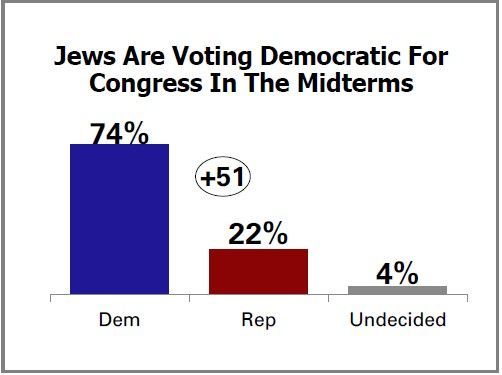
The Democratic Lead In The Jewish Vote Is More Than In The Last Two Trump Presidential Races, But Not Yet Up To The Midterm Margin During The First Trump Administration
National polls have been showing Democrats opening large leads in the generic vote heading into the November midterm elections. This first poll on the Jewish vote for the midterms shows Democrats getting 74% of the Jewish vote, compared to 22% for Republicans, and 4% undecided among likely voters.
This is a shift from the last two Presidential elections where Republicans, with Trump at the top of the ticket, made slight gains among Jewish voters, closing the margin to -44 points in 2020 and -42 in 2024. But it is still not up to the level of the 2018 midterm results in the first Trump administration, when exit polls showed Jews voting Democratic for Congress by a 64-point margin (82%-18%). The margin in 2018 was the largest in decades, second only to the 2006 midterms when Democrats won the Jewish vote in the midterms of President George W. Bush’s second term by 76 points during the Iraq war.
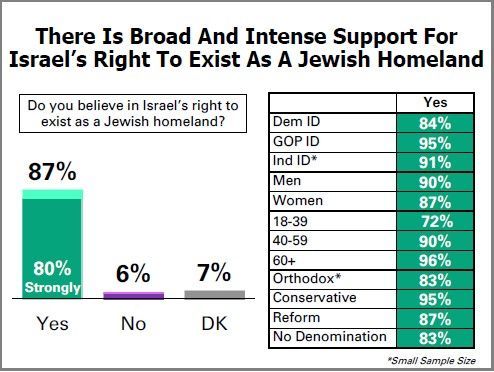
Nearly All Jews Believe In Israel’s Right To Exist As The Jewish Homeland
Despite these somewhat mixed signals on zionism, 87% of American Jews say they believe in Israel’s right to exist as the Jewish homeland, including 80% feeling strongly. Only 6% do not. This broad and intense support extends across demographics including Democratic (84%, 75% strongly), Reform (87%, 80% strongly) and Non-denominational Jews (83%, 73% strongly). Even among the younger Jews 72% believe in this, 63% strongly. Among those who say they are not Zionists, 76% believe in the Jewish state’s right to exist, 68% strongly.
Some of this points to different interpretations, even contradictions, on how Zionism is defined or understood. It also raises questions about whether the word itself is becoming stigmatized, even if views on Israel’s right to exist are unchanged.
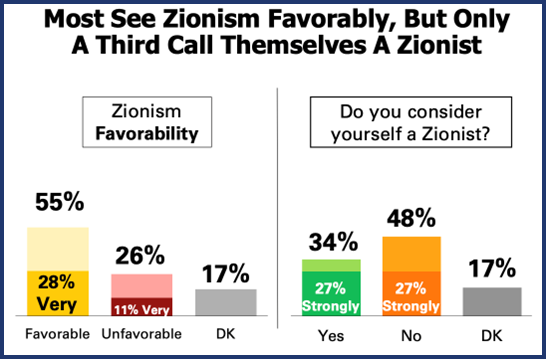
Most Jews See Zionism Favorably, But Only A Third Call Themselves Zionists.
Most Jews (55%) have a favorable view of Zionism, with 26% unfavorable, and 17% not sure. Favorability for Zionism is higher among Republican Jews (74% favorable), Conservative Jews (67%), Orthodox (65%), as well as those with the strongest sense of Jewish identity (66%) and connection to Israel (85%). There are more mixed results among Democrats, 47% of whom are favorable, with 32% unfavorable and 19% unsure; and younger Jews (52% favorable, 34% unfavorable, 14% not sure).
While the majority are favorable towards Zionists, just over a third (34%) consider themselves one. Nearly half (48%) say they are not Zionists, including 27% who feel that way strongly. Another 17% are not sure. Those most likely to call themselves Zionists include Orthodox Jews (58%), those who say being Jewish is very important to them (47%), Republicans (45%), and Conservative Jews (41%). Those more likely to say they are not Zionists include Democrats (Yes 30%, No 52%), Reform Jews (29%, 52%) and those without a denomination (28%, 52%). Over a third of younger (36%) and middle-aged (38%) Jews call themselves Zionists, slightly more than older Jews (30%), but a 52% majority of younger Jews say they do not. This also higher than those middle-aged (45%) or seniors (48%).
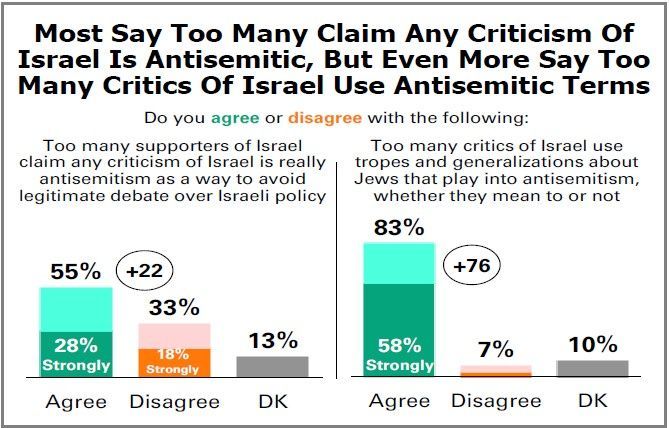
Majorities of Jews See Antisemitism Becoming Too Much A Part of The Debate Over Israel, From Both Sides.
There is broad concern about antisemitism in discourse surrounding Israel. An overwhelming (83%) believe critics of Israel use tropes about Jews that play into antisemitism, whether intentionally or not. This concern is shared by over 80% of demographics including party, gender, age, and denomination. There are some differences in intensity, with 62% of Republicans agreeing strongly, compared to 55% of Democrats; or 65% of seniors feeling strongly, compared to 48% of younger Jews. But clearly there is broad agreement on this.
At the same time there is also a majority, albeit a smaller 55% majority, who believe that even supporters of Israel are also contributing to the problem by using accusations of antisemitism to deflect legitimate criticism of Israeli policy. Democrats are more likely to say this (59%), than Republicans, but even 47% of Republicans share this concern. The majority here holds across both gender and age.
Clearly the use of language, rhetoric and context around antisemitism as well as Zionism are having an impact on the debates over US-Israel issues and bear watching in future research.
Jewish Women Are More Democratic, Fueling The Midterm Margin
The partisan divide is even bigger among women. Nearly three-quarters (74%) of Jewish women identify as Democrats, including 50% who are strong Democrats, and 24% who identify as Democratic Socialists.
Likely Jewish women voters are supporting the Democrats in the generic vote: 78%
Democratic, 19% Republican, and only 3% undecided. The Democratic vote margin increases significantly with age among Jewish women. Women ages 18-29 vote +46 Democratic, rising to +60 among those 40–59 and +58 among those 60 and older. These margins exceed those of the overall Jewish electorate, where voters ages 40–59 and 60+ both register a +48 Democratic advantage. The strength of Jewish identity also follows a consistent pattern. Among women who place lower importance on being Jewish, the Democratic advantage is +74, compared to +61 among the overall electorate. Among those who place higher importance on being Jewish, Jewish women still lean more Democratic than the overall electorate, at +41 versus +36.
Jewish women are also more likely to disapprove of Trump’s job performance and the current U.S military action against Iran. They are four points more likely than the overall electorate to disapprove of Trump’s job performance (77% vs. 73%) and the U.S. military action in Iran (59% vs. 55%).
These findings underscore that Jewish women are not only more Democratic across key demographic and attitudinal dimensions but are also more likely to hold views that reinforce Democratic alignment, helping to fuel the party’s broader electoral advantage.
Despite The Vote, Jews Have Questions On What The Democratic Party Stands For Today
The Jewish electorate continues to be decidedly Democratic, with 69% identifying as Democrats, 24% as Republicans, and only 7% as independents not leaning toward one party or the other. Republican Jews have a more favorable view of their party than Democratic Jews do of theirs. Nearly all Republican Jews (88%) see their party favorably, including 40% very favorably; and only 11% unfavorable. Among Democratic Jews, just over three-quarters (78%) are favorable, and only a third (32%) is very favorable, with nearly one in five (19%) feeling unfavorable about their party.
Jewish voters also have more questions about what Democrats stand for today than Republicans. Among Jews voting Republican in the midterms, 87% said they understand what the Republican party stands for today, with 36% saying they understand very well, compared to only 13% who said they did not know or were unsure. Among Jews voting Democratic in the midterms, only 71% had a good understanding of what the party stands for, compared to 29% either not understanding or unsure.
Even with Democratic Jews having questions about their own party, there is more clarity and unity about how they see the GOP. Nearly all Jewish Democrats (94%) have an unfavorable view of the Republican Party, including 80% very unfavorable. This reverse partisanship is also seen among Republican Jews, but at slightly lower levels, with 84% having an unfavorable view of the Democratic party, 59% very unfavorable, and 12% with a favorable view.
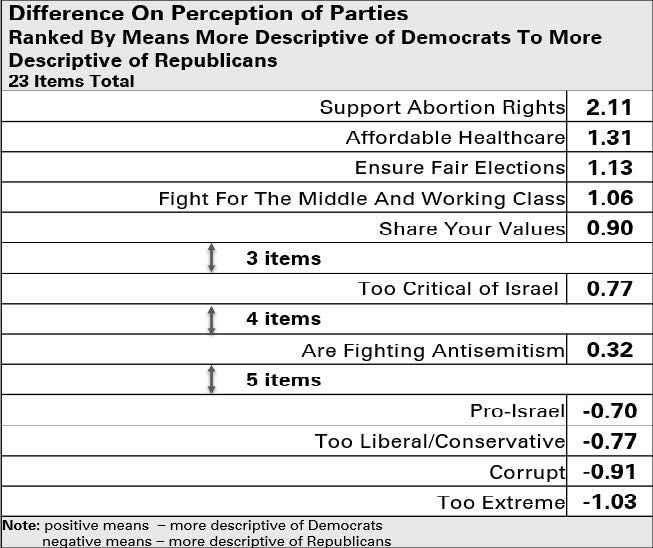
American Jews’ perceptions of the two parties largely favor Democrats, reflecting the large disparity in party identification. Jews identify Democrats most with abortion rights, healthcare, working to ensure fair elections, and fighting for the middle class. These are also traits where Democrats have their biggest advantage over Republicans.
But Republicans now have an advantage over Democrats in being identified as pro-Israel and preventing Iran from obtaining nuclear weapons. The two biggest changes in perceptions of the parties since the JEI poll of Jews during the last Trump midterm in 2018 are on Iran and Israel. With the Trump Administration now conducting a war against Iran, there is a 29-point increase in Republicans on stopping Iran from getting nuclear weapons.
The next biggest change since 2018 is the 22-point drop in perceptions of the Democratic Party as being pro-Israel. In fact, being pro-Israel and fighting antisemitism are two of the least descriptive phrases about Democrats, along with “strong” and “gets things done”. Even among Jewish Democrats, those same four items (pro-Israel, antisemitism, strong, and gets things done) are the least descriptive of the party.
In contrast, the strongest perceptions of the Republican party with the Jewish community are around being pro-Israel, which is the most descriptive item, followed by preventing Iran from getting nuclear weapons, patriotic, strong, and fighting antisemitism.
The biggest image advantage for Republicans over Democrats is that Democrats are much more likely to be seen as “too critical of Israel”.
The Mellman Group
Named “Pollster of the Year” three times by the American Association of Political Consultants, The Mellman Group has provided sophisticated opinion research and strategic advice to political leaders, public interest organizations, Fortune 500 companies, and government agencies for over 30 years. All told, The Mellman Group has helped win over fifty senate and gubernatorial races, and nearly one hundred House race contests. More at https://mellmangroup.com/.
Jewish Electorate Institute
JEI is the foremost resource on Jewish voter political preferences, producing the top research, polling, and analysis critical to understanding the Jewish electorate. Chair Barbara Goldberg Goldman said, “The findings in this poll are consistent with our prior research. They underscore the critical reality that the Jewish community is not monolithic. Its concerns and interests extend well beyond Israel and the current war with Iran. At the same time, these results highlight an urgent need for greater education about Israel’s history and a clearer understanding of what Zionism actually means and how it came into being. This poll is also another reminder that the Jewish vote cannot and should not be taken for granted. Jewish voters are thoughtful and engaged.”