U.S. Jews United Behind Israel As A Jewish Homeland, But Less Clear On Zionism; Most See Rising Use Of Antisemitism In Debates On US-Israel Issues

To: Jewish Electorate Institute
From: The Mellman Group
Re: U.S. Jews United Behind Israel As A Jewish Homeland, But Less Clear On
Zionism; Most See Rising Use Of Antisemitism In Debates On US-Israel Issues
Date: April 13, 2026
This analysis is based on the findings of a survey of 800 registered Jewish voters nationally. The survey was conducted using a high-quality online national panel from March 13-23, 2026. The margin of error for the sample as a whole is +/- 3.5% at the 95% level of confidence (higher for subgroups).
Amid debates in the Jewish community over Israel, war in Iran and election politics, American Jews are united in support of Israel’s right to exist as a Jewish state and homeland for the Jewish people. However, there are mixed signals over the concept of Zionism, with the majority seeing Zionism favorably, but only a third calling themselves Zionists.
There is also concern about how antisemitism is becoming a part of the increasingly heated discussions over U.S.-Israel issues, by both sides. A large majority of U.S. Jews see too many critics of Israel using language about Jews that play into antisemitism, whether intended or not. At the same time, a majority of Jews feel too many supporters of Israel use claims of antisemitism to avoid legitimate debate over policy.
Most Jews See Zionism Favorably, But Only A Third Call Themselves Zionists.
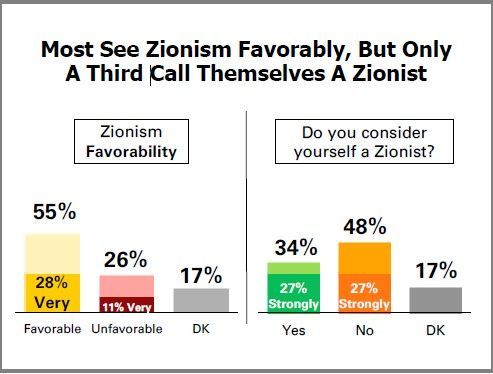
Most Jews (55%) have a favorable view of Zionism, with 26% unfavorable, and 17% not sure.
Favorability for Zionism is higher among Republican Jews (74% favorable), Conservative Jews (67%), Orthodox (65%), as
well as those with the strongest sense of Jewish identity (66%) and connection to Israel (85%). There are more mixed results among Democrats, 47% of whom are favorable, with 32% unfavorable and 19% unsure; and younger Jews (52%
favorable, 34% unfavorable, 14% not sure).
While the majority are favorable towards Zionists, just over a third (34%) consider themselves one. Nearly half (48%) say they are not Zionists, including 27% who feel that way strongly. Another 17% are not sure. Those most likely to call themselves Zionists include Orthodox Jews (58%), those who say being Jewish is very important to them (47%), Republicans (45%), and Conservative Jews (41%). Those more likely to say they are not Zionists include Democrats (Yes 30%, No 52%), Reform Jews (29%, 52%) and those without a denomination (28%, 52%). Over a third of younger (36%) and middle-aged (38%) Jews call themselves Zionists, slightly more than older Jews (30%), but a 52% majority of younger Jews say they do not. This also higher than those middle-aged (45%) or seniors (48%).
Nearly All Jews Believe In Israel’s Right To Exist As The Jewish Homeland
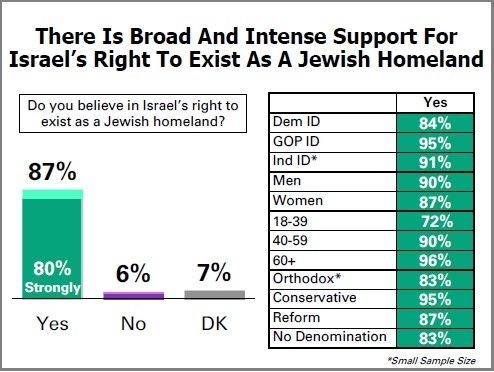
Despite these somewhat mixed signals on zionism, 87% of American Jews say they believe in Israel’s right to exist as the Jewish homeland, including 80% feeling strongly. Only 6% do not. This broad and intense support extends across
demographics including Democratic (84%, 75% strongly), Reform (87%, 80% strongly) and Nondenominational
Jews (83%, 73% strongly). Even among the younger Jews 72% believe in this, 63% strongly. Among those who say they are not Zionists, 76% believe in the Jewish state’s right to exist, 68% strongly.
Some of this points to different interpretations, even contradictions, on how Zionism is defined or understood. It also raises questions about whether the word itself is becoming stigmatized, even if views on Israel’s right to exist are unchanged.
Majorities of Jews See Antisemitism Becoming Too Much A Part of The Debate Over Israel, From Both Sides.
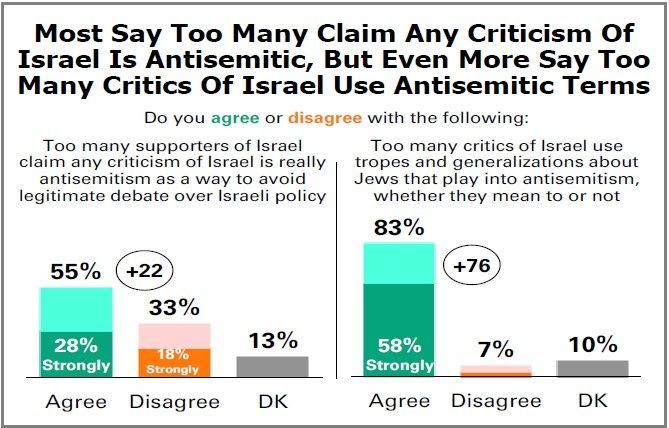
There is broad concern about antisemitism in discourse surrounding Israel. An overwhelming (83%) believe critics of Israel use tropes about Jews that play into antisemitism, whether intentionally or not. This concern is shared by over 80% of demographics including party, gender, age, and denomination. There are some differences in intensity, with 62% of
Republicans agreeing strongly, compared to 55% of Democrats; or 65% of seniors feeling strongly, compared to 48% of younger Jews. But clearly there is broad agreement on this.
At the same time there is also a majority, albeit a smaller 55% majority, who believe that even supporters of Israel are also contributing to the problem by using accusations of antisemitism to deflect legitimate criticism of Israeli policy. Democrats are more likely to say this (59%), than Republicans, but even 47% of Republicans share this concern. The majority here holds across both gender and age.
Clearly the use of language, rhetoric and context around antisemitism as well as Zionism are
having an impact on the debates over US-Israel issues and bear watching in future research.
###