Poll Shows Jews Voting Democratic In Midterms, But GOP Holds Edge On Israel

To: Jewish Electorate Institute
From: The Mellman Group
Re: Poll Shows Jews Voting Democratic In Midterms, But GOP Holds Edge On Israel
Date: April 13, 2026
This analysis is based on the findings of a survey of 800 registered Jewish voters nationally. The survey was conducted using a high-quality online national panel from March 13-23, 2026. The margin of error for the sample as a whole is +/- 3.5% at the 95% level of confidence (higher for subgroups).
Our latest JEI poll shows American Jews are voting heavily Democratic in the midterm election for Congress. At the same time, Jews have questions about what the Democratic Party stands for, particularly on Israel. Republicans, on the other hand, are most identified as being pro-Israel, which is also one of their biggest image advantages over Democrats.
The Democratic Lead In The Jewish Vote Is More Than In The Last Two Trump Presidential Races, But Not Yet Up To The Midterm Margin During The First Trump Administration
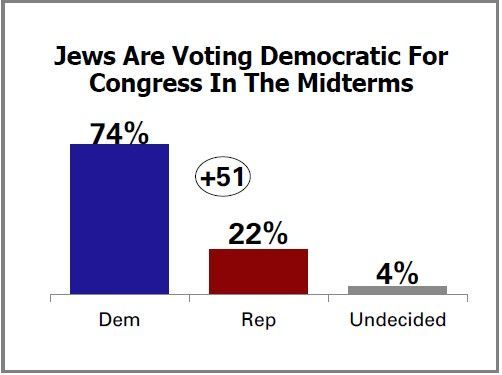
National polls have been showing Democrats opening large leads in the generic vote heading into the November midterm elections. This first poll on the Jewish vote for the midterms shows Democrats getting 74% of the Jewish vote, compared to 22% for Republicans, and 4% undecided among likely voters.
This is a shift from the last two Presidential elections where Republicans, with Trump at the top of the ticket, made slight gains among Jewish voters, closing the margin to -44 points in 2020 and -42 in 2024. But it is still not up to the level of the 2018 midterm results in the first Trump administration, when exit polls showed Jews voting Democratic for Congress by a 64-point margin (82%-18%). The margin in 2018 was the largest in decades, second only to the 2006 midterms when Democrats won the Jewish vote in the midterms of President George W. Bush’s second term by 76 points during the Iraq war.
Jewish Women Are More Democratic, Fueling The Midterm Margin
The partisan divide is even bigger among women. Nearly three-quarters (74%) of Jewish women identify as Democrats, including 50% who are strong Democrats, and 24% who identify as Democratic Socialists.
Likely Jewish women voters are supporting the Democrats in the generic vote: 78% Democratic, 19% Republican, and only 3% undecided. The Democratic vote margin increases significantly with age among Jewish women. Women ages 18-29 vote +46 Democratic, rising to +60 among those 40–59 and +58 among those 60 and older. These margins exceed those of the overall Jewish electorate, where voters ages 40–59 and 60+ both register a +48 Democratic advantage. The strength of Jewish identity also follows a consistent pattern. Among women who place lower importance on being Jewish, the Democratic advantage is +74, compared to +61 among the overall electorate. Among those who place higher importance on being Jewish, Jewish women still lean more Democratic than the overall electorate, at +41 versus +36.
Jewish women are also more likely to disapprove of Trump’s job performance and the current U.S military action against Iran. They are four points more likely than the overall electorate to disapprove of Trump’s job performance (77% vs. 73%) and the U.S. military action in Iran (59% vs. 55%).
These findings underscore that Jewish women are not only more Democratic across key demographic and attitudinal dimensions but are also more likely to hold views that reinforce Democratic alignment, helping to fuel the party’s broader electoral advantage.
Despite The Vote, Jews Have Questions On What The Democratic Party Stands For Today
The Jewish electorate continues to be decidedly Democratic, with 69% identifying as Democrats, 24% as Republicans, and only 7% as independents not leaning toward one party or the other. Republican Jews have a more favorable view of their party than Democratic Jews do of theirs. Nearly all Republican Jews (88%) see their party favorably, including 40% very favorably; and only 11% unfavorable. Among Democratic Jews, just over three-quarters (78%) are favorable, and only a third (32%) is very favorable, with nearly one in five (19%) feeling unfavorable about their party.
Jewish voters also have more questions about what Democrats stand for today than Republicans. Among Jews voting Republican in the midterms, 87% said they understand what the Republican party stands for today, with 36% saying they understand very well, compared to only 13% who said they did not know or were unsure. Among Jews voting Democratic in the midterms, only 71% had a good understanding of what the party stands for, compared to 29% either not understanding or unsure.
Even with Democratic Jews having questions about their own party, there is more clarity and unity about how they see the GOP. Nearly all Jewish Democrats (94%) have an unfavorable view of the Republican Party, including 80% very unfavorable. This reverse partisanship is also seen among Republican Jews, but at slightly lower levels, with 84% having an unfavorable view of the Democratic party, 59% very unfavorable, and 12% with a favorable view.
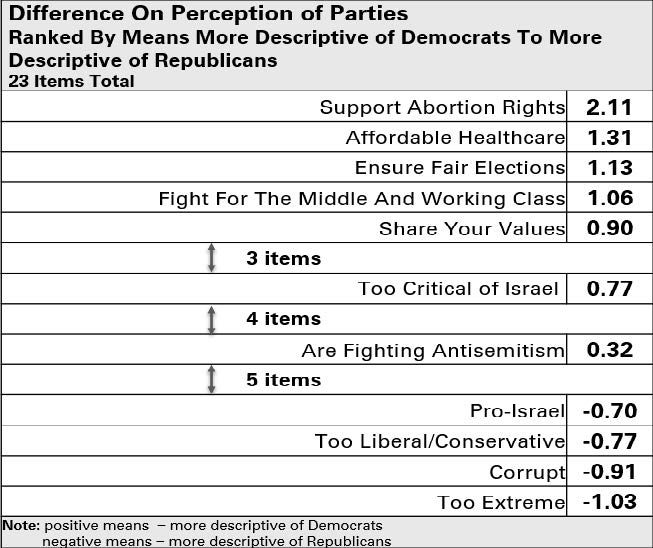
American Jews’ perceptions of the two parties largely favor Democrats, reflecting the large disparity in party identification. Jews identify Democrats most with abortion rights, healthcare, working to ensure fair elections, and fighting for the middle class. These are also traits where Democrats have their biggest advantage over Republicans.
But Republicans now have an advantage over Democrats in being identified as pro-Israel and preventing Iran from obtaining nuclear weapons. The two biggest changes in perceptions of the parties since the JEI poll of Jews during the last Trump midterm in 2018 are on Iran and Israel. With the Trump Administration now conducting a war against Iran, there is a 29-point increase in Republicans on stopping Iran from getting nuclear weapons.
The next biggest change since 2018 is the 22-point drop in perceptions of the Democratic Party as being pro-Israel. In fact, being pro-Israel and fighting antisemitism are two of the least descriptive phrases about Democrats, along with “strong” and “gets things done”. Even among Jewish Democrats, those same four items (pro-Israel, antisemitism, strong, and gets things done) are the least descriptive of the party.
In contrast, the strongest perceptions of the Republican party with the Jewish community are around being pro-Israel, which is the most descriptive item, followed by preventing Iran from getting nuclear weapons, patriotic, strong, and fighting antisemitism.
The biggest image advantage for Republicans over Democrats is that Democrats are much more likely to be seen as “too critical of Israel”.
###