Survey Shows Most U.S. Jews Are Not Following Pro-Israel Spending In ’26 Primaries And Are Divided On Its Value
To: Jewish Electorate Institute
From: The Mellman Group
Re: Survey Shows Most U.S. Jews Are Not Following Pro-Israel Spending In ’26
Primaries And Are Divided On Its Value
Date: April 6, 2026
This analysis is based on the findings of a survey of 800 registered Jewish voters nationally. The survey was conducted using a high-quality online national panel from March 13-23, 2026. The margin of error for the sample as a whole is +/- 3.5% at the 95% level of confidence (higher for subgroups).
Our latest JEI poll finds that the majority of American Jews identify as both pro-Israel and critical of the Israeli Government. There is limited awareness of the spending by pro-Israel groups in the 2026 primaries, with only one in ten saying they have heard a great deal about it. Attitudes split on partisan lines with majorities of independent and Republican Jews supporting this spending, while a plurality of Democrats are opposed. But still, the majority of Democrats are either not sure or supportive.
Attitudes about AIPAC and DMFI, the pro-Israel groups spending the most in these primaries, are also split on partisan lines with AIPAC slightly underwater among Democrats, and popular among Republicans. DMFI is less known, but better liked among Democrats.
The Majority Of U.S. Jews Identify As Both Pro-Israel And Critical Of Israeli Policies
An overwhelming 86% of American Jews describe themselves as generally pro-Israel. However, fewer than a quarter (23%) say they are both pro-Israel and supportive of Israeli policies. A 63% majority identify as pro-Israel and critical of the Israeli government policies – split roughly equally between those who are critical of some policies (32%) and those critical
of many (31%). Just 14% say they are not generally pro-Israel (9%) or do not hold a view (5%).
While pro-Israel sentiment extends across party (84% of Democrats, 90% of independents, 94% of Republicans), Democrats are considerably more likely to be critical of Israeli policies (73% critical) than independents (44%) and Republicans (39%).
Relatively Few Are Paying Close Attention To The Pro-Israel Role In The 2026 Primaries
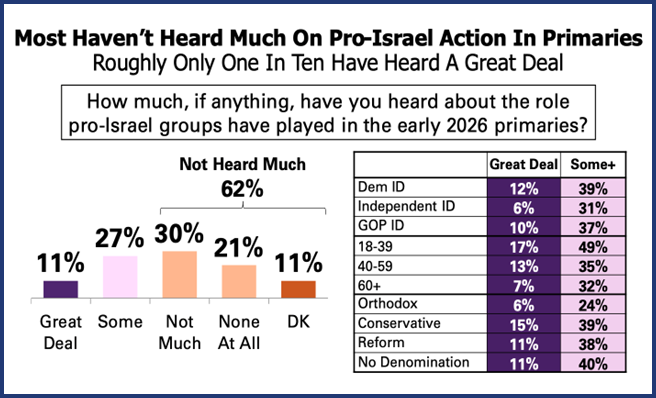
Despite the media coverage of the involvement in pro-Israel groups in the recent primaries, few Jews have been following this closely. Just 38% say they have heard at least some about these efforts; and only 11% have heard a great deal. The majority (62%) say they have not heard much, including 32% who say they have heard nothing at all or are unsure. This limited awareness extends across party with similar numbers across Democrats (12% great deal, 27% some) and Republicans (10%, 27%) and slightly lower levels among independents (6%, 25%). There is a bit more awareness among
younger Jews. Nearly half (49%) of those under 40 years old say they have heard something about the pro-Israel involvement in the 2026 primaries. Less than a fifth (17%) say they have heard a great deal.
Given More Information, There Are Clear Divisions Along Partisan Lines About Spending Millions To Elect The Most Pro-Israel Candidates – Though Nearly A Third Are Unsure
After hearing that “pro-Israel groups have spent millions of dollars against candidates in primary elections who they believe are not supportive enough of the U.S.-Israel relationship” - opinions are divided. A narrow plurality of 37% supports the involvement, with 32% opposed and 31% unsure.
The few who have already heard a great deal about the primaries are majority opposed (60%), compared to only 32% support. But the bigger difference is on partisanship. The pro-Israel spending in the primaries is supported by majorities of both Republicans (73%) and independents (50%). Democrats, on the other hand, are plurality opposed (24% support, 42%
oppose) with over a third (34%) not sure.
There is a slight difference by age groups. Net support is slightly higher among seniors at +10 (38% support, 28% oppose). The middle-aged, 40-59 years old, are +4 (36%, 32%). The youngest cohort, under 40 years old, has slightly lower net support at +3. But all these differences are slight, and in line with partisanship, which is the bigger driver here.
A Narrow Plurality Believe It Is More Important Than Ever To Get Involved In Primaries, But Plurality Of Democrats Believe “Heavy Handed” Tactics Will Make Things Worse.
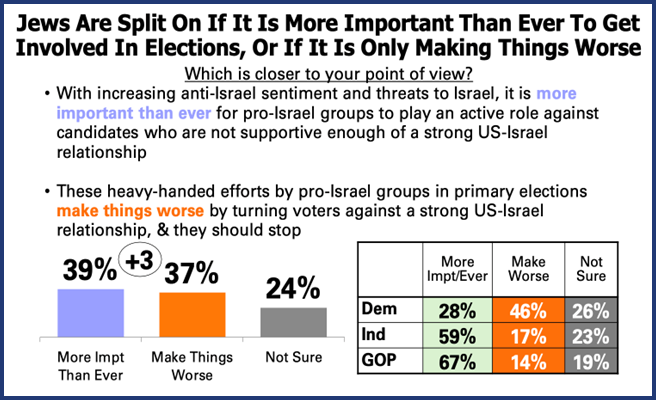
A narrow plurality (39%) believes that “with increasing anti-Israel sentiment and threats to Israel, it is more important than
ever for pro-Israel groups to play an active role against candidates who are not supportive enough of a strong US-Israel
relationship.” Nearly as many (37%) think that “these heavy-handed efforts by pro-Israel groups in primary elections make things worse by turning voters against a strong US-Israel relationship, and they should stop”. Nearly a quarter (24%) are unsure.
Views again diverge based on party. A 46% plurality of Democratic Jews believe this spending will make things worse, while only 28% say it’s more important than ever to take action, and 26% are not sure. Majorities of Republicans (67%) and independents (59%) say it is more important than ever to take action.
AIPAC’s Image Is Net Favorable Overall, But Less Favorable Among Democrats; While DMFI Is Less Known, But Better Liked By Those Who Know Them
The two groups most involved in the pro-Israel spending are the American Israel Public Affairs Committee and the Democratic Majority For Israel. Two-thirds (68%) of Jews know enough about AIPAC to have an opinion, with 39% favorable, 29% unfavorable, and 32% unsure. Again, there is a partisan divide. Republicans are majority favorable (66% favorable, 10%
unfavorable); as are independents (50%, 19%). Democrats are more evenly divided and net unfavorable with 37% unfavorable, 29% favorable, 33% unsure.
DMFI is less well known, with name ID at 48%, but those who know them are 2:1 favorable (32% favorable, 16% unfavorable). As a Democratic organization, they are best known and best liked among Democrats (34% favorable, 13% unfavorable). They are also net favorable among independents (31% favorable, 18% unfavorable) but only barely so among Republicans
(25% favorable, 24% unfavorable).
J Street is the least well known, with name ID at 37%. Jewish voters are divided on J Street with 18% favorable and 19% unfavorable. J Street is net favorable among Democrats (19% favorable, 14% unfavorable). Independents (20% favorable, 34% unfavorable) and Republicans (13% favorable, 29% unfavorable) are net unfavorable.
###