POLL: Domestic issues dominate the priorities of the Jewish electorate
Summary:
On behalf of the Jewish Electorate Institute (JEI), Greenberg Research conducted a survey of 1,000 Jewish voters [1]
to understand what drives their engagement in politics in advance of the 2020 elections. The results demonstrate that domestic issues dominate the policy priorities of the Jewish community as they determine which candidate to support in the 2020 election, as opposed to issues related to Israel, which remains the lowest policy priority of Jewish voters. The results also demonstrate that the Jewish American electorate remains overwhelmingly opposed to President Trump, motivated largely by the Jewish community’s positions on domestic policy issues. These include immigration and health care, as well as concerns about rising anti-Semitism, gun violence, and rise of white nationalism, which respondents partially attribute to President Trump.
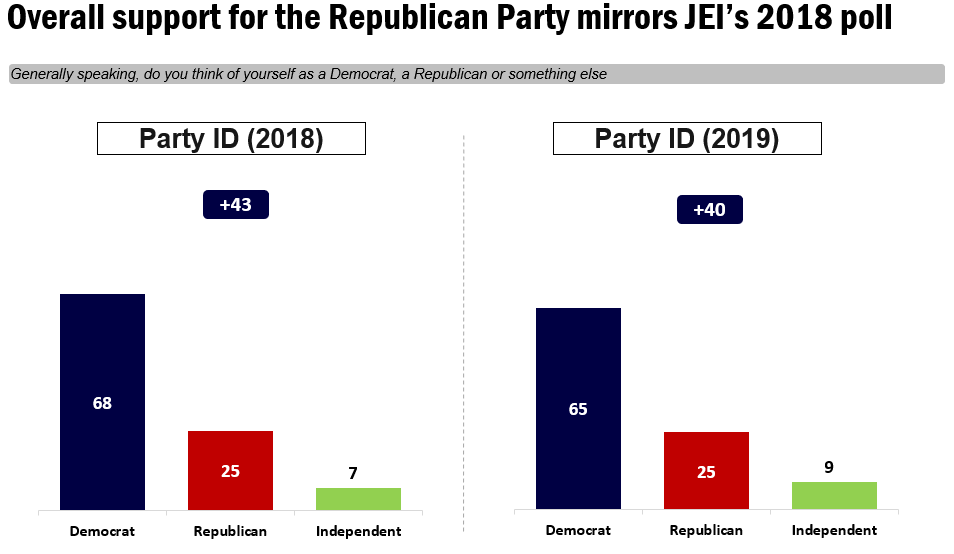
Nearly three-quarters (73 percent) of Jewish voters believe Jewish Americans are less secure than they were two years ago, 71 percent disapprove of the way President Trump has handled anti-Semitism, and nearly 60 percent believe that he bears at least some responsibility for the shootings at synagogues in Pittsburgh and Poway. Two-thirds of the Jewish electorate remains firmly aligned with the Democratic Party, and there has been no change in the percentage of Jewish voters identifying as Republicans since JEI’s October 2018 poll; it remains at 25 percent.
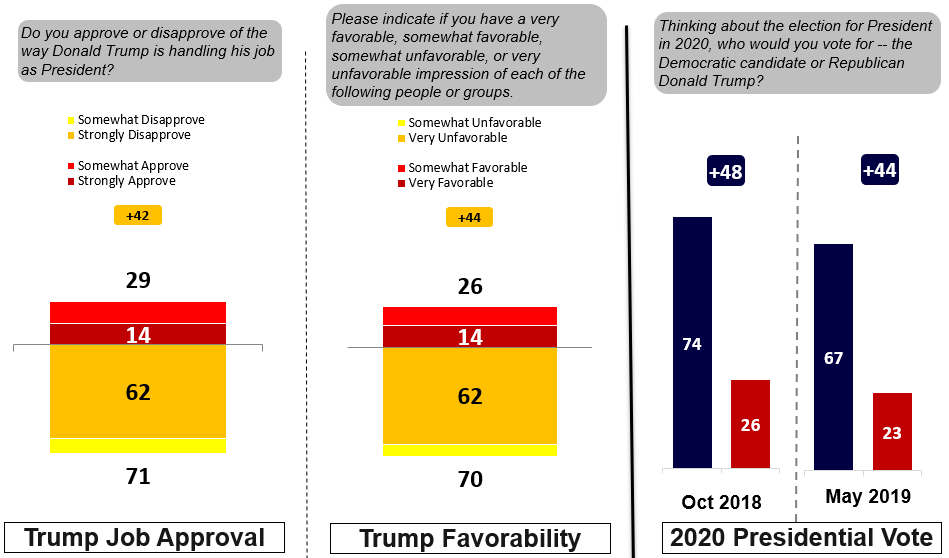
Finally, the results demonstrate Jewish voters’ view of President Trump and how they plan to vote in the 2020 election: 71 percent disapprove of President Trumps’ overall job performance, 70 percent view him unfavorably, 67 percent would vote for a generic Democrat over President Trump, and 65 percent would vote for Democratic candidate Joe Biden over President Trump.
Key Findings:
- Healthcare remains a top policy priority for Jewish voters. As JEI found in its October 2018 poll, a broad majority within the Jewish community prioritize protecting Medicare and Social Security, as well as health care, above other policy issues when determining which candidate to support. These policy priorities are consistent with values long-held by leading Jewish organizations and the Jewish community overall.
- Israel is the lowest policy priority for Jewish voters. What is striking in this poll, as well as JEI’s 2018 poll, is that a candidate’s stance on Israel ranks at the bottom of a list of 16 policy priorities of Jewish voters. Overall, the Jewish community continues to identify as strongly pro-Israel and views the Democratic Party as pro-Israel, but Israel remains the lowest policy priority when determining which candidate to support. Similar to the October 2018 poll, while approximately 90 percent of Jewish voters identify as “pro-Israel,” more than half (53 percent) of those polled are critical of at least some of the current Israeli government’s policies.
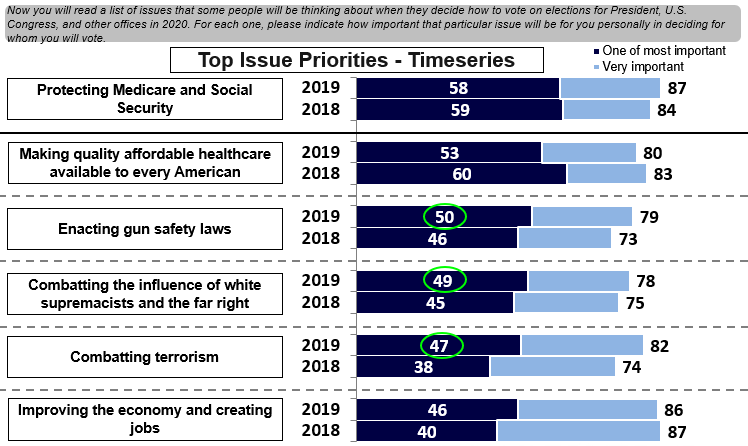
- Anti-Semitism and violent threats to the Jewish community are a growing concern. Perhaps unsurprisingly, given recent attacks against synagogues and other hate crimes,this survey shows increased intensity and prioritization of anti-Semitism and other security threats targeting the Jewish community. Enacting gun safety laws, as well as combatting terrorism, anti-Semitism, and white nationalist threats have all grown in importance as political issues for Jewish voters compared to the October 2018 poll.
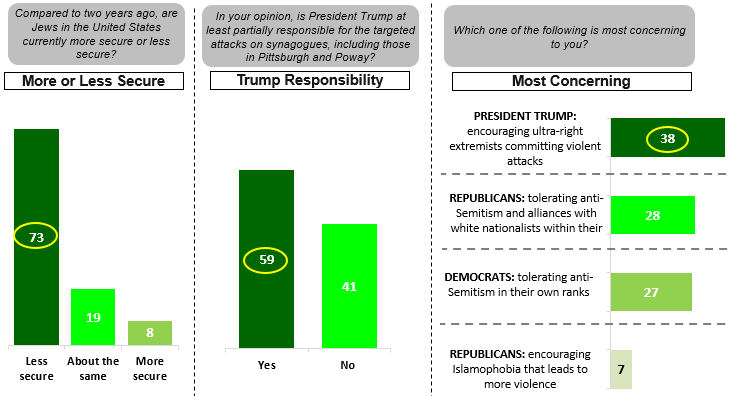
- There is broad agreement that American Jews are less secure than they were two years ago, and many blame President Trump. Nearly three-quarters (73 percent) say Jews in the United States are less secure compared to two years ago. A majority (59 percent) think President Trump is at least partially responsible for recent targeted attacks on synagogues, and a plurality (38 percent) have concerns that President Trump is encouraging violent ultra-right extremists. A broad majority (71 percent) disapprove of President Trump’s handling of anti-Semitism, including a 54 percent majority who strongly disapprove.
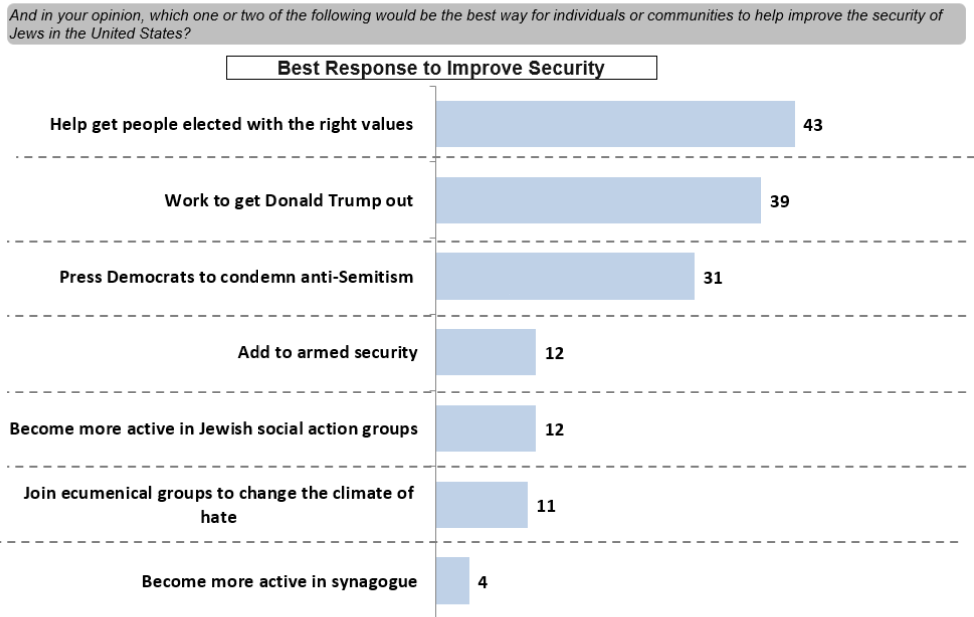
- Insecurity, violence, and rising anti-Semitism are driving Jewish Americans to take political action. When asked what is the best way to improve the security of Jews in the United States, the largest bloc (43 percent) say they are looking to elect a candidate who shares their values, and 39 percent say they want to work to defeat President Trump in 2020. Thirty-one (31) percent want Democrats to do more about anti-Semitism.
- Jews overwhelming oppose President Trump generally, and disapprove of his handling of a wide range of domestic policy issues. This determination to vote for change leaves President Trump with only 23 percent voter support, 29 percent job approval, and 26 percent favorability among Jewish voters. Those are all virtually unchanged from the 2018 JEI poll
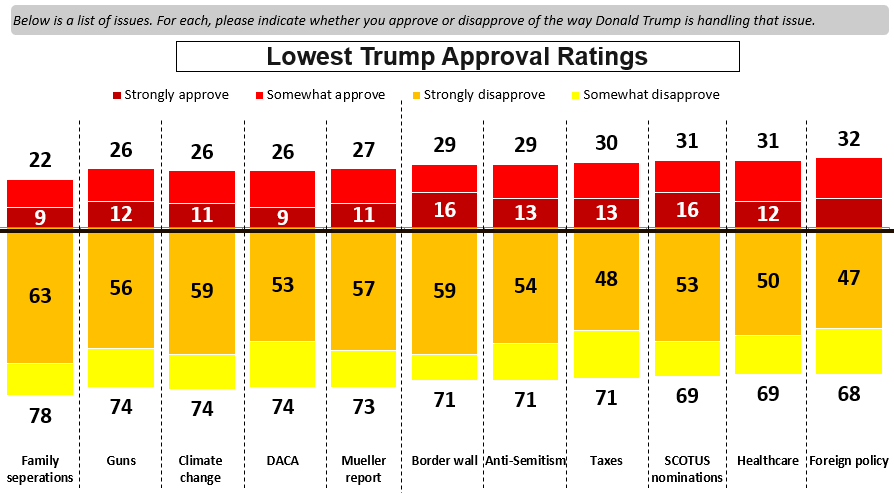
- Jews overwhelmingly disapprove of President Trump’s handling of the majority of policy issues, including many related to his handling of immigration. Out of 23 issues tested, Trump gets some of his lowest ratings on family separations at the Mexican border (78 percent), handling of DACA recipients (74 percent), guns (74 percent), handling of the Mueller Report (73 percent), anti-Semitism (71 percent), building of the border wall (71 percent), taxes (70 percent), Supreme Court nominations (69 percent), healthcare (69 percent), and banning immigration from certain Muslim-majority countries (66 percent).
- There has been no increase in Jewish support for the Republican Party. Since JEI’s October 2018 poll, the percentage of Jewish voters who identify as Republican remains the same (25 percent). The percentage identifying as Democrats or independents also remains steady at 65 percent and 9 percent, respectively.
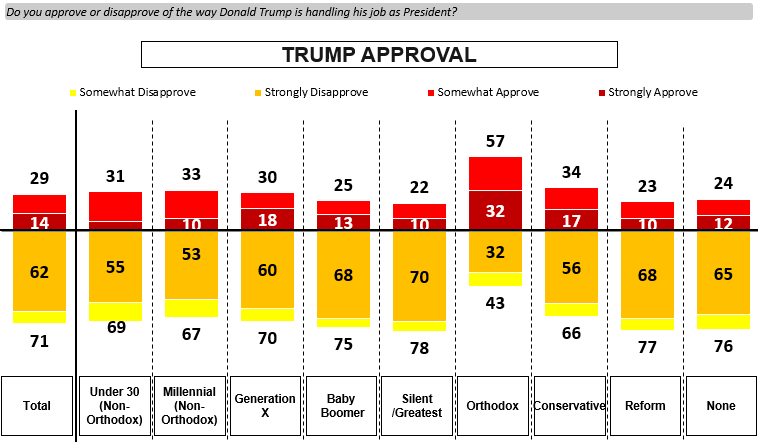
- Millennial Views. This survey includes a large sample of young people (age 18-29) and millennials (under 35), which gives us insights into how young Jewish voters are prioritizing politics. Jewish millennials are voting similar to other American millennials. They are more racially diverse and culturally liberal; they are also pro-immigration, including support for immigrants from Muslim-majority countries. Two-thirds of those polled disapprove of President Trump. A generic Democrat wins 61 percent of their vote, and they are more open to a third-party candidate, particularly those under 30 years old. Trump only wins 24 percent of non-Orthodox millennial Jews. Compared to other age demographics, disapproval of President Trump is slightly lower among millennial non-Orthodox (67 percent) than older generations of Jewish voters.
Conclusion:
Jewish American voters, including millennials, prioritize domestic policy issues that impact their lives, including health care, anti-Semitism and growing insecurity among American Jews. A candidate’s stance on Israel is of relatively low importance to Jewish voters as they determine which candidate to support in the 2020 election. When it comes to the domestic policy issues that Jewish voters prioritize, they overwhelmingly identify with Democrats and disapprove of the handling of such issues by President Trump. Less than one-quarter of Jewish voters (23 percent) will vote for President Trump in 2020.
###
[1] This online survey took place May 6-12 among 1,000 Jewish voters nationally. Interviews were conducted online though a randomly selected panel. All respondents were screened for Jewish identity and current registration status, and key demographics in the final sample were weighted to reflect the Jewish electorate. The margin of error is +/-3.2 percentage points at the 95 percent confidence level. Please note that the numbers have been rounded by computer and occasionally will add up to slightly above or slightly below 100 percent.